H-HeFT plus meta-analysis
Professor Lars Køber (Rigshospitalet - Copenhagen University Hospital - Copenhagen, Denmark) began with a presentation on the Danish H-HeFT trial, which is part of the 2 × 2 factorial DANHEART trial. H-HeFT assessed hydralazine plus isosorbide dinitrate (H-ISDN) in symptomatic HF patients with LVEF ≤40%, SBP ≥100 mmHg and NT-proBNP >350 pg/mL or BNP >80 pg/mL. A total of 592 participants were randomised to twice-daily hydralazine 37.5 mg plus isosorbide dinitrate 20 mg (with uptitration) or matching placebo. The primary endpoint was death, worsening HF, an urgent outpatient visit resulting in IV therapy or metolazone therapy for HF, heart transplantation or left ventricular assist device implantation. Over follow-up of up to 7 years, there was no significant difference between H-ISDN and placebo for the primary endpoint (8.6 events/100 patient-years vs. 9.3 events/100 patient-years; hazard ratio [HR] 0.90; 95% CI 0.67 to 1.21). All-cause death occurred in 19.4% of patients in the H-ISDN group and 24.2% of patients in the placebo group (HR 0.72; 95% CI 0.51 to 1.02). Prof. Køber commented that the results of the trial may have been impacted by the high number of patients who discontinued H-ISDN treatment.
This was followed by a presentation of a meta-analysis of 3 trials evaluating H-ISDN treatment, which included H-HeFT. In an analysis of data from 2,101 patients, H-ISDN was associated with a reduction in all-cause death (HR 0.71; 95% CI 0.58 to 0.87) and cardiovascular death (HR 0.65; 95% CI 0.47 to 0.90), but hospitalisations for HF results were inconsistent. Substantial differences in trial design, duration of follow-up and background therapies were noted across the trials. “Given the heterogeneity and the tolerability issues, it is difficult to make firm conclusions on the effect of H-ISDN on cardiovascular outcomes,” concluded presenter, Doctor Jawad Haider Butt (Rigshospitalet - Copenhagen University Hospital - Copenhagen, Denmark).
Met-HeFT plus meta-analysis
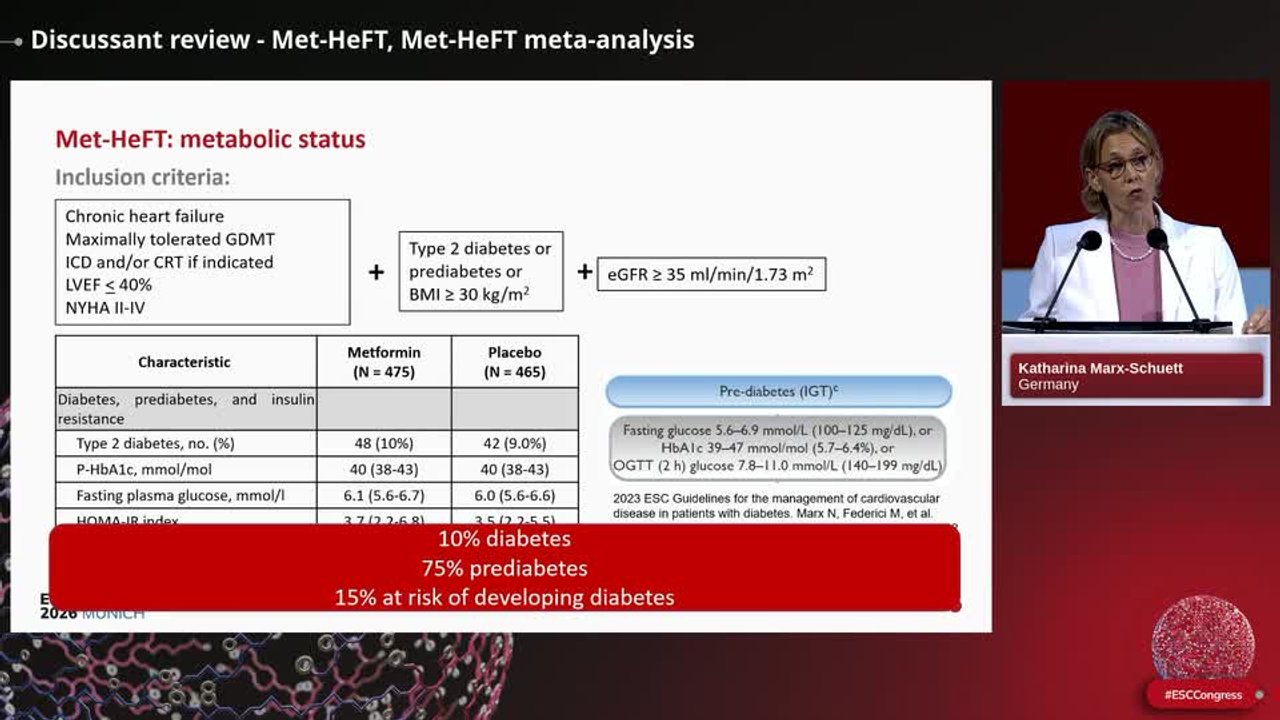
Professor Henrik Wiggers (Aarhus University Hospital - Aarhus, Denmark) presented the Met-HeFT component of DANHEART. Met-HeFT included 940 patients with LVEF ≤40% who had type 2 diabetes, prediabetes or were at increased risk of developing type 2 diabetes. Over a mean follow-up of 3.7 years, there was no significant difference between metformin and placebo for the primary endpoint of death, worsening HF, acute MI or stroke (25.1% vs. 23.4%; HR 1.10; 95% CI 0.84 to 1.42; p=0.48).
A meta-analysis of trials with metformin was then presented, including 3 HF trials (involving 1,077 patients) and 4 ischaemic heart disease trials (involving 1,123 patients). “The meta-analysis came to the same conclusion as the Met-HeFT trial,” noted Associate Professor Anders Hostrup Larsen (Goedstrup Hospital - Herning, Denmark). “There was no significant difference in cardiovascular outcomes with metformin in patients with HFrEF and we also showed no significant effect in established ischaemic heart disease.”
LUMINARA
As explained by Professor James Januzzi (Baim Institute for Clinical Research, Massachusetts General Hospital, Harvard Medical School - Boston, USA), LUMINARA was a phase IIb trial evaluating the oral relaxin agonist, AZD5462, in HF patients on stable maximally tolerated standard-of-care therapies. The study included 235 patients with LVEF ≤35% and 140 patients with LVEF 41–55% who were randomised to placebo or AZD5462 20 mg, 80 mg or 360 mg once daily. Among those with an LVEF ≤35%, AZD5462 had the most beneficial effects at the lowest dose, decreasing the primary endpoint of end systolic volume index by 5.4 mL/m2 from baseline at 24 weeks (p=0.054 vs. placebo). In the LVEF 41–55% cohort, AZD5462 reduced the primary endpoint of systemic vascular resistance index by 19%, 21% and 15% for doses 20 mg, 80 mg and 360 mg, respectively, at 24 weeks (all p≤0.021). It was concluded that larger randomised trials with AZD5462 are now warranted, focused on outcomes.
PADN-PH-LHD
Doctor Shao-Liang Chen (Nanjing First Hospital Nanjing Medical University - Nanjing, China) described the PADN-PH-LHD trial evaluating pulmonary artery denervation (PADN) in 264 patients with heart failure-induced pulmonary hypertension compared with GDMT alone. The primary endpoint was clinical worsening, defined as all-cause mortality, heart or lung transplantation, HF hospitalisation, outpatient worsening HF requiring IV medication or a ≥10% or >30-m absolute decline in 6MWD from baseline. Of note, the primary endpoint was significantly improved with PADN plus GDMT, occurring in 25.7% of patients vs. 51.5% with GDMT alone (HR 0.49; 95% CI 0.30 to 0.82; p=0.0059) after median follow-up of 338 days.
TIME-HF
Finally, Doctor Panniyammakal Jeemon (Sree Chitra Tirunal Institute for Medical Sciences & Technology (SCTIMST) - Thiruvananthapuram, India) described the cluster-randomised TIME-HF trial assessing a nurse-led intervention to improve GDMT uptake and clinical outcomes. In the intervention group, a nurse-coordinated collaborative model was implemented with trained nurses working closely with physicians to deliver integrated care tailored to patients' needs. A mobile health app helped nurses coordinate care and allowed patients to log warning signs and symptoms. Nurses provided structured counselling and education on self-care. A total of 1,507 patients with HFrEF were involved; 57% lived in rural areas.
The use of GDMT was consistently higher in the intervention group than in the usual-care group. In addition, the probability of surviving up to 2 years without hospitalisation was significantly higher with the intervention than with usual care (84.0% vs. 79.4%; p<0.001). Importantly, there was also a 22% reduction in deaths in the intervention group (p=0.028) at 2 years. “We believe this model is not only relevant to low- and middle-income countries but also to other settings around the world where adherence to GDMT is suboptimal,” concluded Dr. Jeemon.