EMAIL-HF
Can a digital strategy improve implementation of SGLT2 inhibitors in patients with heart failure?
Presenter, Doctor Mariam Elmegaard (Herlev and Gentofte University Hospital - Copenhagen, Denmark) explained why the EMAIL-HF trial was carried out: “SGLT2 inhibitors have proven benefits in the treatment of HF and yet, as with many evidence-based therapies, adoption in routine clinical practice is limited. Often, patients are not followed in specialist HF clinics, but receive care in general cardiology, primary care or other nonspecialist settings,” she said. Dr. Elmegaard and collaborators tested a novel digital implementation approach, investigating whether SGLT2 inhibitor therapy could be increased by using nationwide health registries to identify untreated patients at the population level and proactively invite them for a specialist consultation.
In EMAIL-HF, all patients with HF in the Capital Region of Denmark and the municipality of Roskilde who were not receiving SGLT2 inhibitor therapy were identified. Eligible patients were assigned to a digital strategy or usual care. Patients randomised to the digital strategy were sent a letter through the governmental Digital Post system with information about SGLT2 inhibitors and were offered a telephone-based consultation with an HF specialist. During the consultation, the specialist reviewed the patient's electronic health record and determined whether initiation of an SGLT2 inhibitor was appropriate according to current ESC Guidelines. Patients assigned to usual care did not receive the digital letter and continued to receive routine care.
A total of 5,996 patients were randomised who had mean duration of HF of around 5 years. Among patients assigned to the digital strategy, 60% responded to the invitation and signed up on the digital platform.
The main finding was that initiation of SGLT2 inhibitor therapy more than doubled with the digital strategy. The primary outcome of initiation of dapagliflozin or empagliflozin within 6 months occurred in 18.6% of patients in the digital-strategy group and 8.2% in the usual-care group (p<0.001). The difference was maintained at 24 months.
The secondary outcome of hospitalisation for HF or death from any cause occurred in 13.0% of patients in the digital-strategy group and 14.0% in the usual-care group (p=0.276). Dr. Elmegaard said: “Because only a proportion of patients responded to the invitation and initiated treatment, the difference in SGLT2 inhibitor use between the groups was limited. Based on the observed effect on the clinical outcomes, a much larger study would have been needed to reliably detect a difference.” Safety outcomes were infrequent, with no evidence of excess events in the digital-strategy group.
Dr. Elmegaard concluded, “Our findings show that digital systems can be developed that proactively identify and contact patients who are missing out, helping more patients to receive guideline-recommended treatment in a timely manner, without relying on their next hospital visit or hospitalisation. If adopted more widely, this type of digital strategy could help narrow the gap between medical evidence and the care patients actually receive.”
Remote Exercise SWEDEHEART
Comparing remote vs. centre-based cardiac rehabilitation after an MI
“Despite the benefits, participation in cardiac rehabilitation at healthcare centres remains low. Only a minority – around 15% – of eligible patients in Sweden and across Europe complete a supervised centre-based exercise programme,” noted Professor Maria Bäck (Sahlgrenska University Hospital - Gothenburg, Sweden). “We conducted the Remote Exercise SWEDEHEART study to test the hypothesis that remotely delivered exercise-based cardiac rehabilitation, embedded in healthcare services, may be a valuable addition to centre-based programmes, potentially increasing participation while maintaining safety and clinical effectiveness,” she said.
Remote Exercise SWEDEHEART is an ongoing registry-based, cluster-randomised crossover trial including patients with type 1 MI aged 18–79 years. During 15-month intervention periods, 23 Swedish centres offered patients remotely delivered exercise, centre-based exercise or a combination of both, according to patient preference. During control periods, patients were offered centre-based exercise only. After 15 months, each centre crossed over to the alternate mode for a further 15 months. Both remote and centre-based exercise followed the same principles of individually prescribed aerobic and resistance training, with progression based on clinical assessment and established cardiac rehabilitation guidelines. Remotely delivered cardiac rehabilitation consisted of real-time, group-based video sessions, where patients exercised at home while a physiotherapist at the hospital supervised and led the session.
The researchers found that remotely delivered exercise did not significantly increase the mean number of completed exercise sessions. Across the study population of 3,112 patients, the proportion who completed the full exercise programme was very similar: 13.8% during the intervention period and 13.6% during the control period.
It was noted that remote exercise was clearly used when it was available. During intervention periods, approximately 38% of recorded exercise sessions were performed remotely, while approximately 62% were performed at a centre. Both groups improved their physical capacity after finishing the exercise programme, with no significant difference between the groups.
Discussing the implications, Prof. Bäck said: “Our findings suggest that remotely delivered exercise-based cardiac rehabilitation should be viewed as an additional patient-centred option, rather than a replacement for centre-based rehabilitation or a stand-alone solution for poor uptake. It appears that there are other participation barriers that are not related to travelling, which may include other co-existing diseases, language barriers, socioeconomic factors and varying levels of digital health literacy.” Follow-up will continue and data from a wider group of patients from the SWEDEHEART registry will also be analysed.
ADHERE-ASCVD
Can digital outreach improve statin adherence?
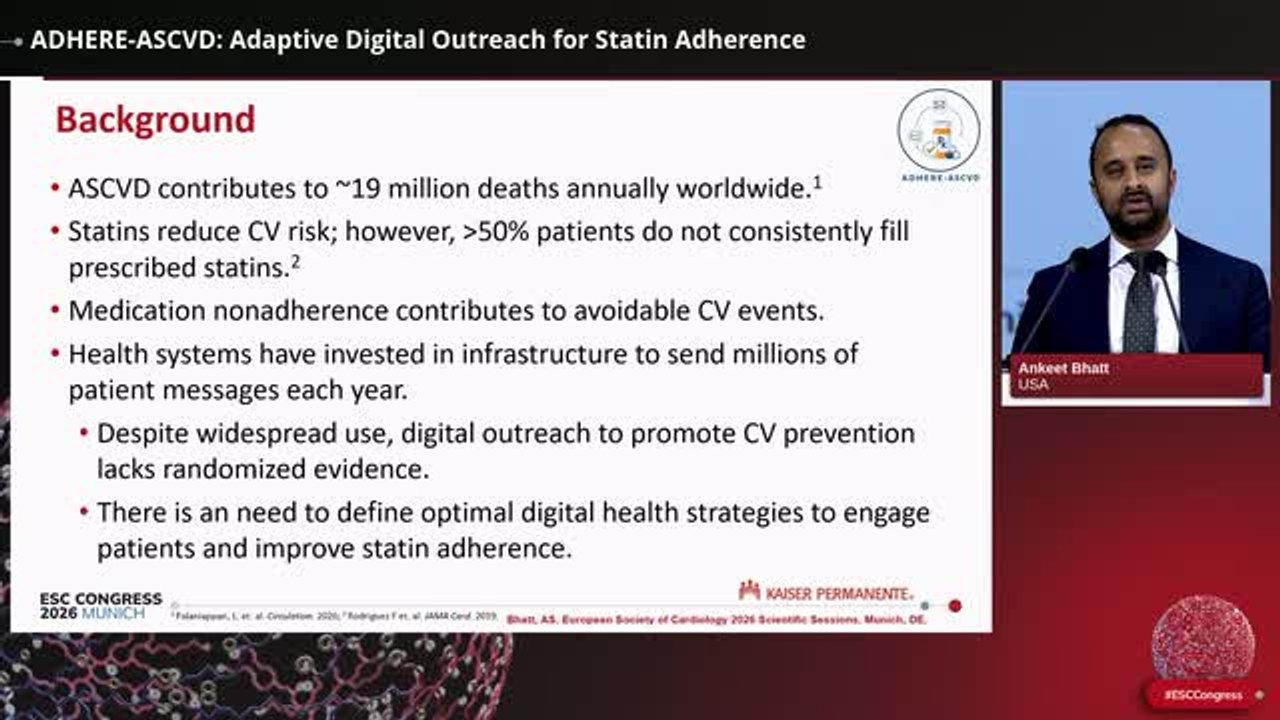
Statin non-adherence remains a leading, addressable driver of preventable cardiovascular events worldwide. Doctor Ankeet Bhatt (Kaiser Permanente SF Medical Center & Division of Research - San Francisco, USA) described the ADHERE-ASCVD trial testing whether an adaptive, sequential digital outreach strategy could improve statin refills in 20,604 adults with low statin adherence compared with usual care communications.
Participants were individually randomised to secure portal messaging, SMS text messaging, non-secure email message or usual care. Participants who did not refill within 14 days after initial outreach ("non-responders") were individually randomised to a second-stage strategy consisting of digital outreach (via either the same or switched outreach modality or usual care).
Initial digital outreach increased the primary endpoint of 14-day statin refill compared with usual care (14.4% vs. 12.0%; p<0.0001). Among individual strategies, secure portal messaging had the largest improvement vs. usual care (14.9%), followed by SMS (14.4%) and non-secure email (13.9%). Among initial non-responders, second-stage outreach incrementally increased refill rates vs. usual care (13.0% vs. 10.4%; <0.0001). Switching modality did not outperform repeating the same modality. “These findings support scalable, adaptive health system outreach strategies to close gaps in cardiovascular prevention,” concluded Dr. Bhatt.
VIRTUES
Evaluating a virtual e-health system (VIRTUES) to monitor cardiac implantable electronic devices
Professor Ratika Parkash (Dalhousie University - Halifax, Canada) presented results from two trials testing a novel approach to follow-up cardiac implantable electronic devices. The VIRTUES virtual e-health system uses transmission reports sent from the patient’s implanted device to the physician, who then reviews the data and sends messages to the patient on how well their device is working. The VIRTUES PM and ICD trials explored the use of this platform with pacemakers and ICDs, respectively, evaluating safety and efficacy, and also cost effectiveness.
Across 13 centres in Canada, 1,115 patients with either a compatible pacemaker or an ICD were randomised to the VIRTUES platform (remote monitoring with virtual care communications only) or to standard care (in-clinic visits with or without remote monitoring) for 18 months. Unscheduled in-clinic visits were used as needed in both arms to address device-related concerns.
The investigators found that the VIRTUES system was as safe and as effective as standard care. There was noninferiority for the primary safety outcome of death, stroke, cardiovascular- or device-related hospitalisation over 18 months in both the ICD trial (11.0% vs. 11.2%; p=0.007 for noninferiority) and the pacemaker trial (6.1% vs. 7.4%; p=0.0213 for noninferiority).
Similarly, there was no difference for the primary efficacy endpoint of time from a clinically important event to a clinic decision in response to arrhythmias or device issues in the ICD trial (median difference +1 day; p<0.0001 for noninferiority), with a signal for superiority in the pacemaker trial (median difference −3.25 days; p<0.0001 for noninferiority).
Of note, there was a significant reduction in costs to the healthcare system and to patients. “We estimate this system could save around $10 million annually in Canada alone,” noted Prof. Parkash. An adjusted total difference of $77 Canadian dollars per patient was observed with the VIRTUES platform, primarily due to lower costs to the healthcare system and to patients due to fewer in-clinic visits.
Prof. Parkash highlighted that patients were strongly supportive of this digital approach. She stated that the VIRTUES system gave patients a sense of control – they liked to know directly how well their device was working – and most said they would keep using it if given the opportunity. “We have shown that the VIRTUES system is both patient centric and reduces the clinic burden, which can be challenging to demonstrate in digital health studies,” she noted, concluding: “The VIRTUES system could be scalable for use globally although it has only been tested in Canada so far and further studies would be needed in other regions.”