LIBREXIA ACS
Milvexian after recent ACS
“There has been increasing interest in developing factor XIa inhibitors to prevent harmful thrombosis, while preserving normal clotting processes to minimise bleeding,” commented Professor P. Gabriel Steg (Hôpital Bichat - Paris, France), who continued: “We conducted the LIBREXIA ACS trial to assess the selective factor XIa inhibitor, milvexian, after ACS when added to standard antiplatelet therapy.”
Eligible participants had had an ACS within 7 days, had undergone PCI or were being managed conservatively and had at least two factors associated with increased risk of recurrent ischaemic events. A total of 14,194 participants were randomised to oral milvexian 25 mg twice daily or a matched placebo.
The Independent Data Monitoring Committee recommended trial discontinuation after a preplanned interim analysis showed that it was unlikely to meet its primary endpoint. Futility was confirmed when the data were subsequently analysed. After a median follow-up of 10 months, the primary efficacy endpoint of cardiovascular death, MI or ischaemic stroke was similar: 5.4% with milvexian and 5.1% with placebo (hazard ratio [HR] 1.05; 95% CI 0.91 to 1.21; p=0.50). No difference was observed for the individual components of the primary endpoint or any major secondary efficacy endpoints, including all-cause death. There was no difference in the principal safety endpoint of BARC 3c or 5 bleeding (intracranial or fatal bleeding), which occurred in 0.3% of patients with milvexian and placebo.
Discussing the implications of these findings, Prof. Steg said: “While no effect on efficacy was shown, the absence of an observed increase in intracranial or fatal bleeding is reassuring given that two further trials are ongoing: LIBREXIA AF for patients with atrial fibrillation and LIBREXIA Stroke for secondary stroke prevention. These studies are distinct from LIBREXIA ACS in several aspects, including patient populations, endpoints, type and duration of background therapy and disease pathology.”
PREMIUM
Can aspirin be omitted at the time of primary PCI for STEMI?
Doctor Gaku Nakazawa (Kindai University - Osaka, Japan) explained why PREMIUM was carried out: “Previous randomised trials have demonstrated the safety of 1−3 months of DAPT followed by P2Y12 inhibitor monotherapy compared with 12 months of DAPT. However, the safety of initiating prasugrel as monotherapy at the time of contemporary imaging-guided PCI compared with standard 12-month DAPT remains unknown.”
In the PREMIUM trial conducted in Japan, 2,280 participants with a STEMI indicated for primary PCI with current generation platinum chromium everolimus-eluting stents were randomised to either prasugrel monotherapy (20 mg loading, 3.75 mg daily) initiated before PCI or standard DAPT with aspirin plus prasugrel for 12 months. Patients at high bleeding risk in the DAPT group could receive DAPT for 3 months then prasugrel monotherapy at the clinician’s discretion.
Noninferiority was not demonstrated for prasugrel monotherapy compared with DAPT for the primary endpoint of all-cause death, MI or stroke at 12 months (11.0% vs. 8.5%; HR 1.34; 95% CI 1.02 to 1.75; p=0.40 for noninferiority). As noninferiority was not met, the major secondary endpoint related to bleeding was not analysed statistically. BARC type 3 or 5 bleeding occurred in 5.6% of patients in the prasugrel monotherapy group and 8.4% of patients in the DAPT group at 12 months (HR 0.66; 95% CI 0.47 to 0.91). Stent-related complications (definite or probable stent thrombosis and clinically driven target lesion revascularisation) were similar between groups. In contrast, non-stent related events including non-target lesion revascularisation were more frequent with prasugrel monotherapy.
“These findings do not support prasugrel monotherapy at the time of primary PCI for STEMI,” concluded Dr. Nakazawa. “It appears that DAPT is needed for at least the first month but the optimum duration of DAPT remains to be determined.”
SWITCH SWEDEHEART
What are the effects of switching from a default policy of ticagrelor to prasugrel in patients with ACS?
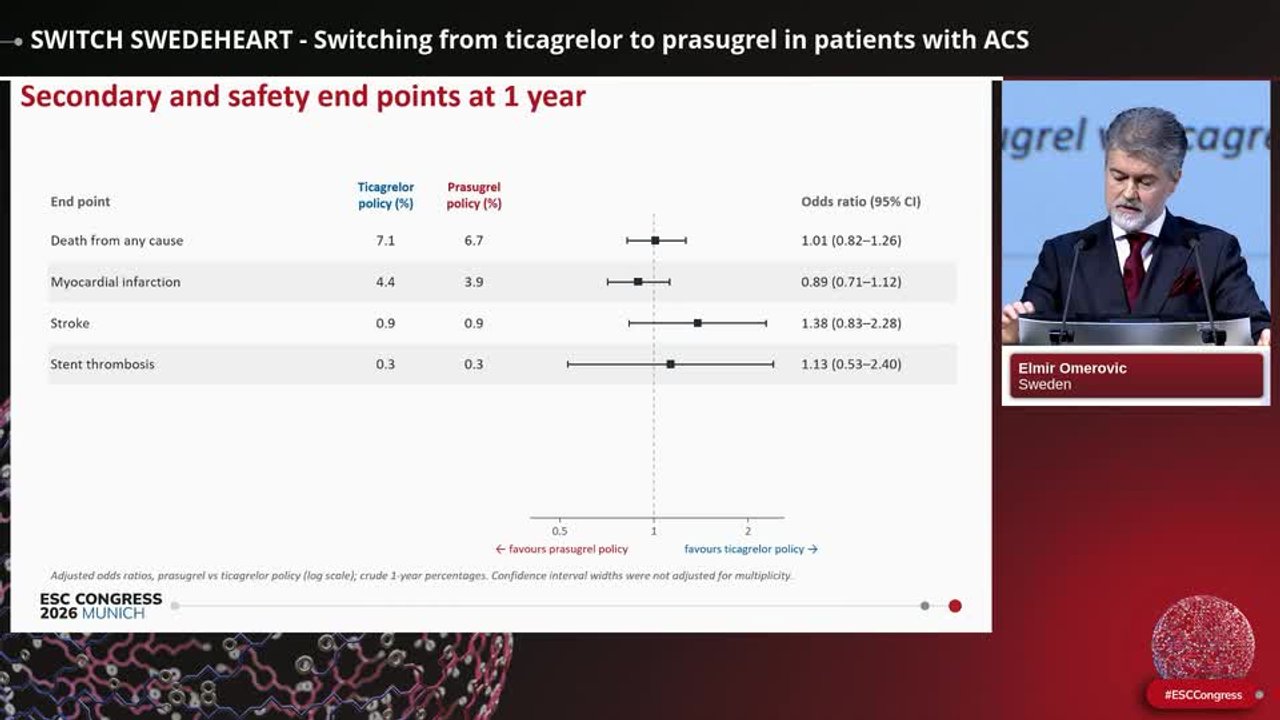
2023 ESC Guidelines state that prasugrel should be considered in preference to ticagrelor for ACS patients who undergo PCI (class IIa, Level B) [1]. Describing the rationale for the SWITCH SWEDEHEART trial, Professor Elmir Omerovic (Sahlgrenska University Hospital - Gothenburg, Sweden) said: “Several Swedish healthcare regions decided to adopt prasugrel as the default P2Y12 inhibitor for ACS and we used this change as the basis for a pragmatic evaluation of a default prasugrel policy compared with ticagrelor using the established SWEDEHEART registry platform.”
In the stepped-wedge trial, seven Swedish regions in three clusters switched their default P2Y12 inhibitor from ticagrelor to prasugrel at staggered, randomly assigned times. Data from all 17,095 consecutive adults with ACS undergoing PCI were analysed, including elderly patients and those with prior stroke or an indication for oral anticoagulation. Under the ticagrelor policy, 9,444 patients were recommended to receive ticagrelor 90 mg twice daily. Under the prasugrel policy, 7,651 patients were recommended to receive prasugrel 10 mg once daily (5 mg once daily if aged ≥75 years or weighing <60 kg, as per the label).
The primary endpoint of all-cause death, MI or stroke at 1 year occurred in 11.1% of patients under the prasugrel policy and 11.8% under the ticagrelor policy (adjusted odds ratio [OR] 0.90; 95% CI 0.77 to 1.06). The individual components of the primary endpoint did not differ. Of note, the risk of major bleeding at 1 year was significantly lower with the prasugrel policy compared with the ticagrelor policy (4.2% vs. 4.4%; OR 0.80; 95% CI 0.64 to 0.99).
Commenting on the first of the trial’s main conclusions, Prof. Omerovic said: “In the largest randomised comparison to date, prasugrel offered comparable protection against major cardiovascular events, but with a signal toward less bleeding and lower cost – a potentially important consideration for patients and healthcare systems.” Secondly, he noted the success of the novel methodology: “We were able to run a large policy-level, randomised trial within a national registry at a fraction of the cost of a conventional trial, evaluating the impact of two treatments and an important healthcare change in real-world patients. Our trial represents a model of clinical evidence generation that could be used to great effect across cardiology and in many other areas of healthcare.”
A-CLOSE
How does clopidogrel compare with extended DAPT after high-risk PCI?
Professor Byeong-Keuk Kim (Severance Cardiovascular Hospital, Yonsei University College of Medicine - Seoul, South Korea) presented results from the A-CLOSE trial conducted in South Korea. A total of 3,203 patients were included who had undergone drug-eluting stent implantation 12 months earlier and had at least one high-risk clinical feature (ACS, diabetes, chronic kidney disease, heart failure, prior stroke or peripheral artery intervention) or high-risk lesion feature (left main, bifurcation, chronic total occlusion, multivessel disease or diffuse long lesions). Participants were randomised to clopidogrel monotherapy or extended DAPT.
After 24 months, the primary endpoint of all-cause death, MI, stent thrombosis, stroke or BARC type 2, 3 or 5 bleeding with clopidogrel monotherapy was noninferior to extended DAPT (5.0% vs. 5.1%; p=0.001 for noninferiority). Of note, a key ischaemic endpoint occurred more frequently with clopidogrel monotherapy than with extended DAPT (all-cause mortality, MI, stent thrombosis or stroke: 3.7% vs. 1.6%; p<0.001). All-cause mortality occurred in 1.3% of patients with clopidogrel monotherapy and 0.4% of patients with DAPT. A key bleeding endpoint occurred less frequently with clopidogrel monotherapy (BARC type 2, 3 or 5 bleeding: 1.8% vs. 4.1%; p<0.001).
Concluding, Prof. Kim said: “It seems that no single strategy is best for every patient, but rather, long-term antiplatelet therapy should be individualised according to ischaemic and bleeding risks, clinical characteristics and treatment preferences in a shared decision-making process between patients and physicians.”
EPIDAURUS
Evaluating potent P2Y12 inhibitors in patients with AF and MI
Professor Konstantinos Rizas (Ludwig Maximilians University - Munich, Germany and Cantonal Hospital St. Gallen - St Gallen, Switzerland) explained that the optimal antithrombotic regimen for patients suffering from both AF and MI remains unclear.
The EPIDAURUS trial compared a 1-month regimen of a direct oral anticoagulant (DOAC; edoxaban, apixaban and rivaroxaban) plus prasugrel or ticagrelor (experimental group) vs. a DOAC plus clopidogrel with in-hospital aspirin (control group). Eligible patients had AF and an MI within 5 days of randomisation.
The trial, which was conducted in Germany and Austria, was prematurely terminated after enrolment of 602 of the planned 1,474 patients due to safety concerns raised by the Data and Safety Monitoring Board. In the 6 weeks after randomisation, the incidence of BARC ≥3 bleeding was more than threefold higher in the experimental group compared with the control group (BARC 3 or more: HR 3.54; 95% CI 1.15 to 10.85; p=0.028).
There was no difference between the groups for all primary and secondary efficacy endpoints at 6 weeks and 6 months when the effect of therapy was tested for various ischaemic outcomes, such as cardiovascular death, MI and stroke. “In the first trial of its kind, we have answered an important clinical question,” concluded Prof. Rizas. “These findings do not support the routine use of potent P2Y12 inhibitors in combination with direct oral anticoagulants in patients with AF and MI.”