DISCO plus meta-analysis
Professor Sten Rubertsson (Uppsala University - Uppsala, Sweden) presented results from the DISCO trial in which 1,006 unconscious patients with witnessed out-of-hospital cardiac arrest (OHCA), return of spontaneous circulation and without ST-elevation were randomised to immediate coronary angiography (within 120 minutes) or to a deferred strategy in which coronary angiography was intended to be delayed for at least 72 hours.
No difference in the primary endpoint of survival at 30 days was observed between immediate and deferred coronary angiography (54.6% vs. 53.6%; hazard ratio [HR] 0.95; 95% CI 0.74 to 1.21; p=0.67). Similarly, there was no difference between the groups for survival at 180 days and secondary endpoints related to neurological recovery.
Ms Lente Pol (Radboud University Medical Centre - Nijmegen, the Netherlands) then presented an individual patient data meta-analysis of 5 trials, which included DISCO and involved data from 2,173 patients. There was no difference in 30-day survival between those who received immediate coronary angiography and those who did not. “These results show that we can safely delay coronary angiography in patients after OHCA without ST-elevation,” she concluded.
HeartRunner
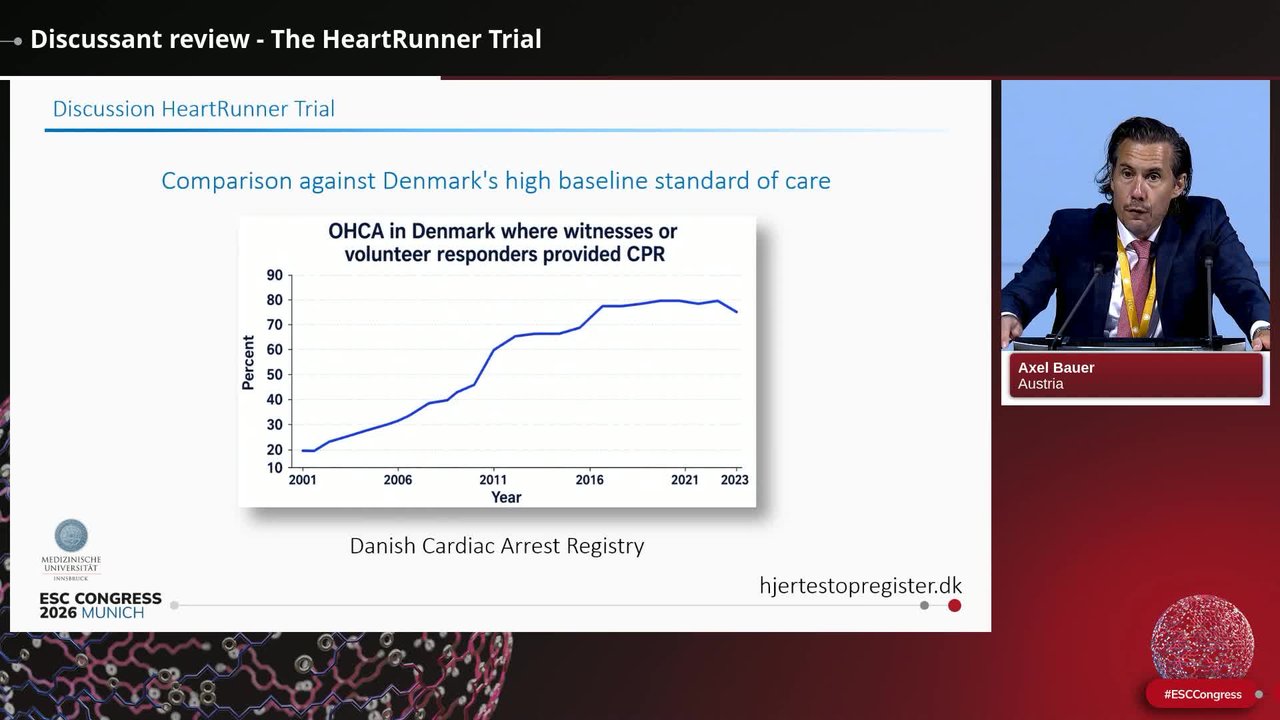
Professor Fredrik Folke (Copenhagen University Hospital - Copenhagen, Denmark) described the HeartRunner trial, which evaluated the impact of community responders on patient outcomes after OHCA. Emergency calls for suspected OHCA in the Capital Region of Denmark were randomised to community first responder activation plus standard response or standard response alone. Across 2,060 suspected cardiac arrests, the primary endpoint of 30-day survival was the same whether first responders were present or not. However, community first responder activation did significantly increase the rate of bystander CPR and doubled the rate of bystander defibrillation. Explaining why he thought the primary results were neutral, Prof. Folke said: “The trial was conducted in an area where ambulance response times were around 7 minutes. When this interval is short, the incremental benefit of responder-initiated defibrillation may be limited. It would be interesting to assess the impact of community first responders in regions with slower ambulance responses, including more rural areas.”
PRAGUE-26
Next, Professor Viktor Kočka (Charles University and University Hospital Kralovske Vinohrady - Prague, Czechia) explained that the PRAGUE-26 trial was designed to challenge the current standard of care in intermediate–high risk acute pulmonary embolism. A total of 558 patients with acute intermediate−high risk pulmonary embolism were randomised to catheter-directed thrombolysis (CDT; without ultrasound facilitation) or standard anticoagulation therapy alone. The primary endpoint was all-cause mortality, pulmonary embolism recurrence or cardiorespiratory decompensation/collapse (defined according to pre-specified criteria) within 7 days of randomisation. The primary endpoint was significantly reduced in the CDT group compared with the standard-care group (0.7% vs. 6.8%; relative risk 0.10; 95% CI 0.02 to 0.44; p<0.001). This difference was driven primarily by a lower rate of cardiorespiratory decompensation or collapse with CDT. There was no apparent difference in bleeding events with CDT vs. standard care within 7 days (4.6% vs. 5.0%; p=0.846). There were 2 cases of intracranial bleeding in the CDT group and none in the standard-care group. There were 4 deaths in the standard-care group within 7 days and 1 death in the CDT group within 30 days. “We hope the results from our trial with CDT will help to inform future recommendations,” Prof. Kočka said.
LAACS-2
Associate Professor Helena Dominguez (Bispebjerg University Hospital - Copenhagen, Denmark) and colleagues previously conducted the LAACS trial in patients undergoing open-heart surgery. She noted: “We conducted the much larger LAACS-2 trial to further investigate if LAA closure has a protective effect in patients with, but mostly without, prior AF.” A total of 1,500 patients undergoing first-time planned open-heart surgery without AF and those with a previous diagnosis of paroxysmal or chronic AF were randomised to concomitant LAA closure or standard care. Before surgery, 4.1% had AF. Over 4 years’ follow-up, there was no significant difference in the primary endpoint of stroke or transient ischaemic attack with LAA closure vs. standard care (4.28% vs. 5.04%; HR 0.85; 95% CI 0.53 to 1.37; p=0.517). Of note, patients who had the highest stroke risk at baseline (CHA2DS2-VASc score above the median) had a 56% reduction in the primary endpoint with LAA closure (p=0.018), while no significant benefit was observed in those with lower stroke risk. “Our results do not support routine LAA closure in all patients undergoing planned cardiac surgery; however, closure appeared to confer protection in patients at high risk of stroke. As we saw in the LAACS trial, the primary endpoint curves diverged over time in LAACS-2 and follow-up will be continued,” concluded Associate Prof. Dominguez.