CARDIO-TTRansform
Eplontersen in transthyretin amyloid cardiomyopathy
The TTR gene silencer, eplontersen, is approved for the treatment of hereditary transthyretin amyloid polyneuropathy. As described by Doctor Mathew Maurer (Columbia University Irving Medical Centre - New York, USA), the CARDIO-TTRansform trial investigated eplontersen in patients with transthyretin amyloidosis with cardiomyopathy (ATTR-CM).
A total of 1,432 patients with wild-type or hereditary ATTR-CM were enrolled who were receiving available standard of care. Participants were randomised to receive eplontersen 45 mg or placebo by subcutaneous injection every 4 weeks.
The primary endpoint was a composite of cardiovascular mortality and recurrent cardiovascular events. There were 381 primary endpoint events in 210 patients receiving eplontersen compared with 392 events in 231 patients receiving placebo (rate ratio 0.89; 95% CI 0.73 to 1.09; p=0.277).
In a prespecified subgroup analysis, patients who were not on stabiliser therapy (43%) at baseline experienced fewer primary composite events with eplontersen monotherapy vs. placebo and this result was nominally significant. In patients who were on stabiliser therapy at baseline (57%), no treatment effect was observed. “In CARDIO-TTRansform, the largest ATTR-CM trial to date, we did not demonstrate a significant difference between eplontersen and placebo,” concluded Dr. Maurer. “These findings will inform clinical practice and the evaluation of TTR-lowering treatment strategies in ATTR-CM.”
SINGLE-AF
Should patients with AF at intermediate stroke risk receive direct oral anticoagulants?
Professor Boyoung Joung (Yonsei University - Seoul, South Korea) explained: “Evidence from observational studies with anticoagulants, particularly vitamin K antagonists, remains conflicting in those at intermediate risk. SINGLE-AF was conducted to provide the first evidence from a randomised trial on whether newer direct oral anticoagulants (DOACs) are beneficial in patients with AF at intermediate risk of stroke.”
A total of 1,803 individuals with AF and an intermediate risk of stroke (CHA2DS2-VASc score of 1 in men or 2 in women) from centres in South Korea were randomised to receive a DOAC (apixaban 5 mg twice daily or rivaroxaban 20 mg once daily) or no anticoagulation.
At 24 months, a 69% reduction in the primary endpoint – a composite of stroke, systemic embolism, major bleeding or cardiovascular death – was observed with DOACs vs. no anticoagulation (0.5% and 1.5%, respectively; p=0.028; HR 0.31; 95% CI 0.10 to 0.94). The difference between the groups appeared to be driven by a lower incidence of ischaemic stroke with DOAC therapy (0.1%) vs. no anticoagulant therapy (1.1%). There was no difference in major bleeding with DOAC therapy (0.3%) and without (0.5%).
Prof. Joung concluded, “We now have evidence from a randomised trial that patients with AF at intermediate stroke risk benefit from DOAC therapy, without an increase in major bleeding. Data from the SINGLE-AF trial may be used to inform future guideline recommendations and reimbursement policies.”
POET-II
Can the duration of antibiotics be tailored in infectious endocarditis?
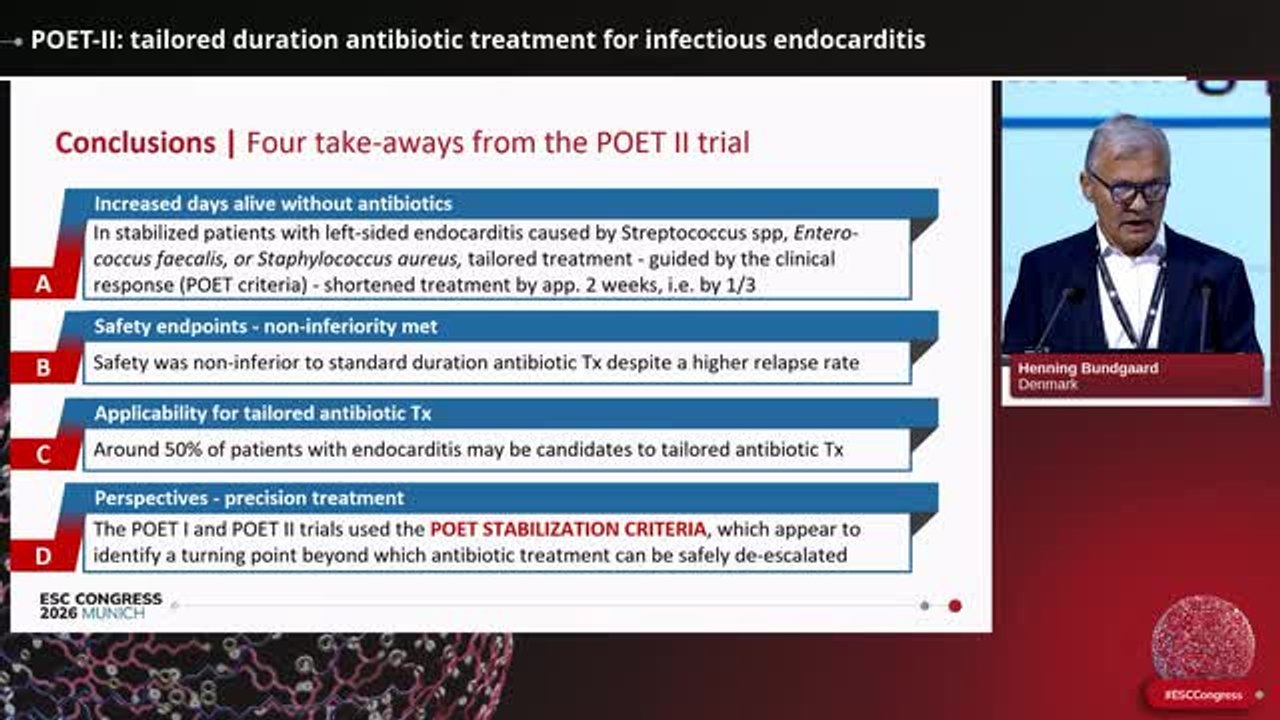
It has been shown previously in the POET-I trial that patients with left-sided infective endocarditis can be safely switched from intravenous antibiotics to oral antibiotics if they fulfil certain clinical, biochemical and imaging criteria – the POET criteria [1]. The investigators turned their attention to individualising the duration of antibiotics. Presenter of the POET-II trial, Professor Henning Bundgaard (Rigshospitalet - Copenhagen University Hospital - Copenhagen, Denmark), explained: “Current recommendations of up to 6 weeks are based mostly on historical observations from the 1950s when lower doses of antibiotic monotherapy were used. We hypothesised that tailoring antibiotic therapy in those who have an initial positive response could safely reduce the duration of antibiotics.”
A total of 508 clinically stable patients with left-sided endocarditis caused by Staphylococcus aureus, Enterococcus faecalis or streptococci were randomised to tailored therapy, with a minimum duration of 2–4 weeks of antibiotic treatment, or to standard therapy. In the tailored-therapy group, antibiotics were discontinued once the predefined minimum treatment duration and POET stabilisation criteria were met.
The tailored strategy reduced treatment duration compared with standard treatment: 26 days vs. 41 days (p<0.001). The primary endpoint – the median number of days alive without antibiotic treatment within 6 months after randomisation – was significantly longer in the tailored-therapy group than in the standard group (183 days vs. 169 days; p<0.001).
The safety endpoint of all-cause mortality, unplanned heart valve surgery or symptomatic embolic events within 6 months occurred in 8.2% of patients in the tailored-therapy group vs. 10.7% on standard therapy, and met noninferiority criteria. Rates of primary relapse were low but were more frequent in the tailored- vs. the standard-therapy group (5.1% vs. 1.6%; p=0.04); however, most were easily managed with reinitiation of antibiotics.
Prof. Bundgaard concluded that around half of patients seen in clinical practice could benefit from tailored reduced-duration antibiotic therapy.
ACACIA-HCM
Aficamten for symptomatic nonobstructive hypertrophic cardiomyopathy
Doctor Ahmad Masri (Oregon Health & Science University - Portland, USA) explained: “Building on our experience in obstructive HCM, we conducted the ACACIA-HCM trial to investigate the effects of aficamten on symptom burden and exercise capacity in patients with non-obstructive HCM.” In this international phase III trial, 517 adults with symptomatic non-obstructive HCM were randomised to aficamten or placebo for up to 72 weeks. The dose of aficamten was adjusted based on LVEF.
Aficamten significantly improved the primary endpoint related to symptom burden. At 36 weeks, Kansas City Cardiomyopathy Questionnaire Clinical Summary Score improved by 11.4 in the aficamten group and 8.4 in the placebo group (p=0.02). Dr. Masri noted that improvements were seen “as early as 12 weeks and there was a pronounced return of symptoms after aficamten treatment was stopped.” Aficamten also significantly improved the primary endpoint related to maximal exercise performance at 36 weeks. pVO2 improved by 0.64 mL/kg/min in the aficamten group and was almost unchanged (−0.03 mL/kg/min) in the placebo group (p=0.003). Significant improvements with aficamten were seen in secondary endpoints including NYHA functional class, submaximal exercise performance and NT-proBNP. There was an increased incidence of patients having LVEF less than 50% with aficamten vs. placebo (10% vs. 1%) but this was managed with dose adjustment.
Concluding, Dr. Masri said: “Results from the ACACIA-HCM trial provide really positive news for patients with symptomatic non-obstructive HCM. For the first time, we have shown clinically meaningful improvements in symptoms and exercise capacity with a treatment that targets the cause of the disease.”
CMR GUIDE
Can cardiac magnetic resonance guide the use of ICDs in patients with mild-moderate left ventricular systolic dysfunction?
As noted by Professor Joseph Selvanayagam (Flinders University, Flinders Medical Centre - Adelaide, Australia), most sudden cardiac deaths occur in patients with mild-to-moderate LVEF reductions who are not currently eligible for an ICD for primary prevention. The CMR GUIDE trial assessed whether an ICD could improve outcomes in patients with LVEF 36–50% who have evidence of myocardial scarring.
A total of 353 patients with ischaemic or non-ischaemic cardiomyopathy, LVEF 36–50% on optimal heart failure therapy and myocardial scarring confirmed by CMR were included. They were randomised to an ICD or an implantable loop recorder (ILR).
The primary endpoint of sudden cardiac death or haemodynamically significant ventricular arrhythmias (ventricular arrhythmias producing loss of consciousness or significant drop in blood pressure) occurred in 7.8% of patients assigned to ICDs and 9.2% assigned to ILRs (HR 0.76; 95% CI 0.37 to 1.58). In a prespecified subgroup analysis, ICD implantation was associated with a 72% reduction in the primary endpoint in patients younger than 70 years, whereas no benefit was observed in patients aged 70 years or older. The secondary endpoint of sudden cardiac death was significantly reduced in the ICD group compared with the ILR group (1.7% vs. 5.8%; HR 0.26; 95% CI 0.07 to 0.95).
“Overall, the primary endpoint was neutral,” concluded Prof. Selvanayagam. “However, younger patients appeared to derive clinical benefit from ICDs. We suggest that data from the CMR GUIDE trial are discussed with younger patients in whom ICDs may be an option in a shared decision-making process.”