For the first time, a Universal Definition of Myocardial Infarction (UDMI) has been developed jointly by four major cardiac societies: the European Society of Cardiology (ESC), the American College of Cardiology (ACC), the American Heart Association (AHA) and the World Heart Federation (WHF).[1]
Here, Chairs of the Task Force of the new Fifth UDMI, Professor Nicholas Mills (for the ESC; University of Edinburgh, UK), Professor Kristin Newby (for the ACC/AHA; Duke University Medical Center, Durham, USA) and Associate Professor Sarah Zaman (for the WHF; University of Sydney, Australia) describe some of the most important changes:
“The main update is that the previous numerical classification of MI has been replaced. The Fifth UDMI has been devised to align with the usual pathway for evaluation of patients with suspected MI, while also considering underlying pathophysiology and incorporating more objective diagnostic criteria to enable more consistent application in practice, research and clinical trials.
Replacing types 1–5 MI, the new classification scheme recognises that MI can arise in three settings. Firstly, MI can occur spontaneously due to an acute coronary pathology (primary MI). Previously, type 1 MI was restricted to atherothrombosis, but the new classification of primary MI considers all acute coronary pathologies, including spontaneous coronary artery dissection (SCAD), vasospasm or coronary embolism, which can be identified using imaging and functional testing. Restenosis, stent thrombosis and graft failure more than 30 days after a procedure are now included in this classification, reflecting that they often represent a primary coronary pathology rather than a complication of revascularisation.
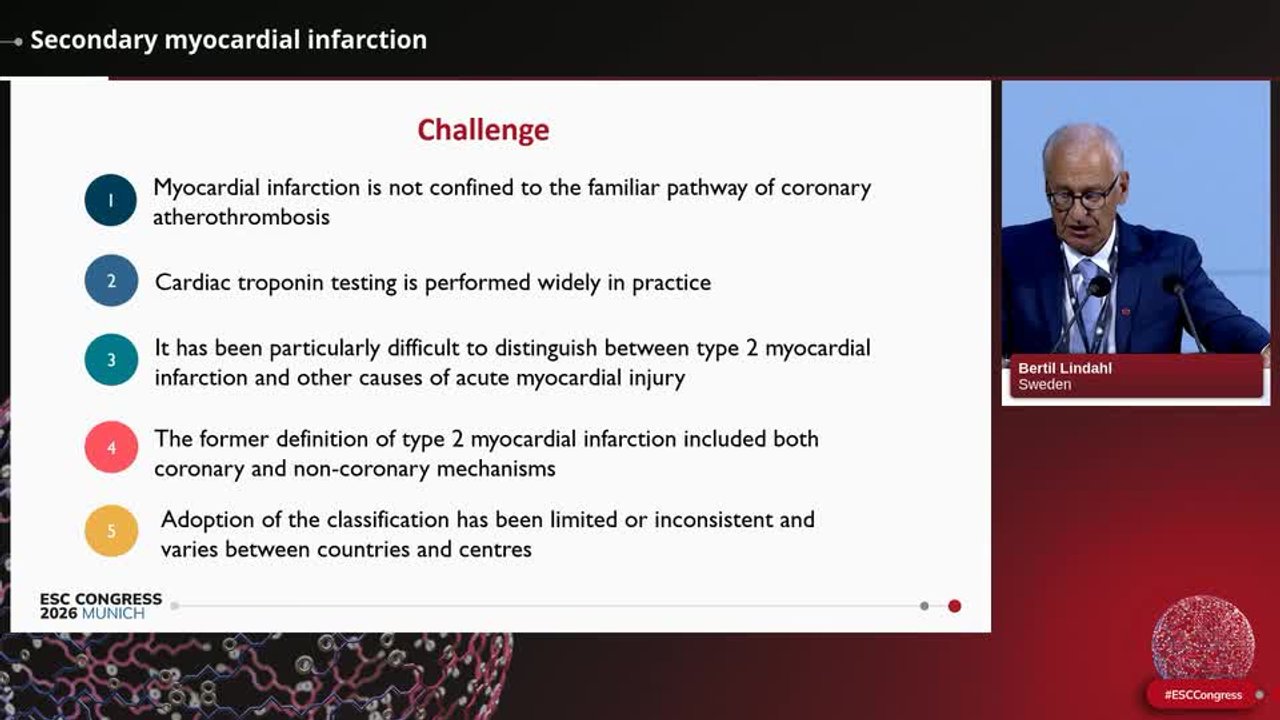
Secondly, MI may result from another acute condition causing oxygen supply–demand imbalance (secondary MI). Replacing type 2 MI, a diagnosis of secondary MI is confirmed if the myocardial ischaemia resulting from supply–demand mismatch is a consequence of obstructive CAD without evidence of an acute coronary pathology and/or the resulting myocardial injury is sufficient to cause a new regional wall motion abnormality or loss of myocardial viability. Objective criteria are proposed to guide the use of cardiac and invasive or non-invasive coronary imaging to reduce uncertainty, promoting consistent diagnosis of secondary MI and to ensure the diagnosis informs treatment.
Thirdly, MI may occur as a complication of percutaneous or surgical cardiac procedures (procedure-related MI). Replacing types 4 and 5 MI, procedure-related MI is considered when acute myocardial ischaemia and injury occur due to a complication of any cardiac procedure (percutaneous or surgical) within 30 days.
All MIs can fit into one of these three clinical categories. Where MI is the likely cause of death (previously called ‘type 3 MI’), the clinical classification (primary, secondary or procedure-related) should be applied based on the setting or post-mortem findings.
In another update, the criteria for acute and chronic myocardial injury have been refined and the underlying mechanisms are discussed. Sex-specific 99th percentile upper reference limits for cardiac troponin are necessary to define myocardial injury and avoid systematic bias that may contribute to under-recognition in females.
In a major step forward, the Task Force has worked with the World Health Organization to propose International Classification of Disease-11th edition (ICD-11) codes that align with the updated classification of MI. While the implementation of ICD-11 coding will take time, it will enable epidemiological research, simplify endpoint classification in clinical trials, facilitate healthcare system planning and public health monitoring of each classification of MI. For example, implementation of codes to identify the acute coronary pathologies of primary MI will provide insights into the incidence of less common mechanisms of primary MI, such as SCAD and vasospasm. In addition, alignment of the Fifth UDMI and ICD-11 coding will facilitate national and international comparisons of care and outcomes using routinely collected healthcare data.
We anticipate that adoption of the Fifth UDMI with ICD-11 codes in practice and research will ensure that a diagnosis of MI is meaningful for patients and clinicians, with clear implications for management across healthcare settings.”
Want to know more? Full details can be found in the European Heart Journal.