Task Force chairs, Professor Maria Bäck (Sahlgrenska University Hospital, Gothenburg, Sweden), Professor Dominique Hansen (Hasselt University, Hasselt, Belgium) and Associate Professor Matthias Wilhelm (Bern University Hospital, Switzerland) presented the ESC’s first guidelines focused on cardiac rehabilitation [1] earlier today.
“Until now, recommendations have been spread across different ESC Guidelines, but the growing number of people living with chronic CVD created a clear need for dedicated guidelines that provide a unified framework for delivering high-quality, accessible and evidence-based cardiac rehabilitation across different patient groups and healthcare settings,” explains Prof. Bäck. The Task Force brought together the best available evidence to demonstrate that cardiac rehabilitation in the post-acute and chronic care of heart disease reduces hospitalisations and also improves physical and mental functioning, and quality of life.
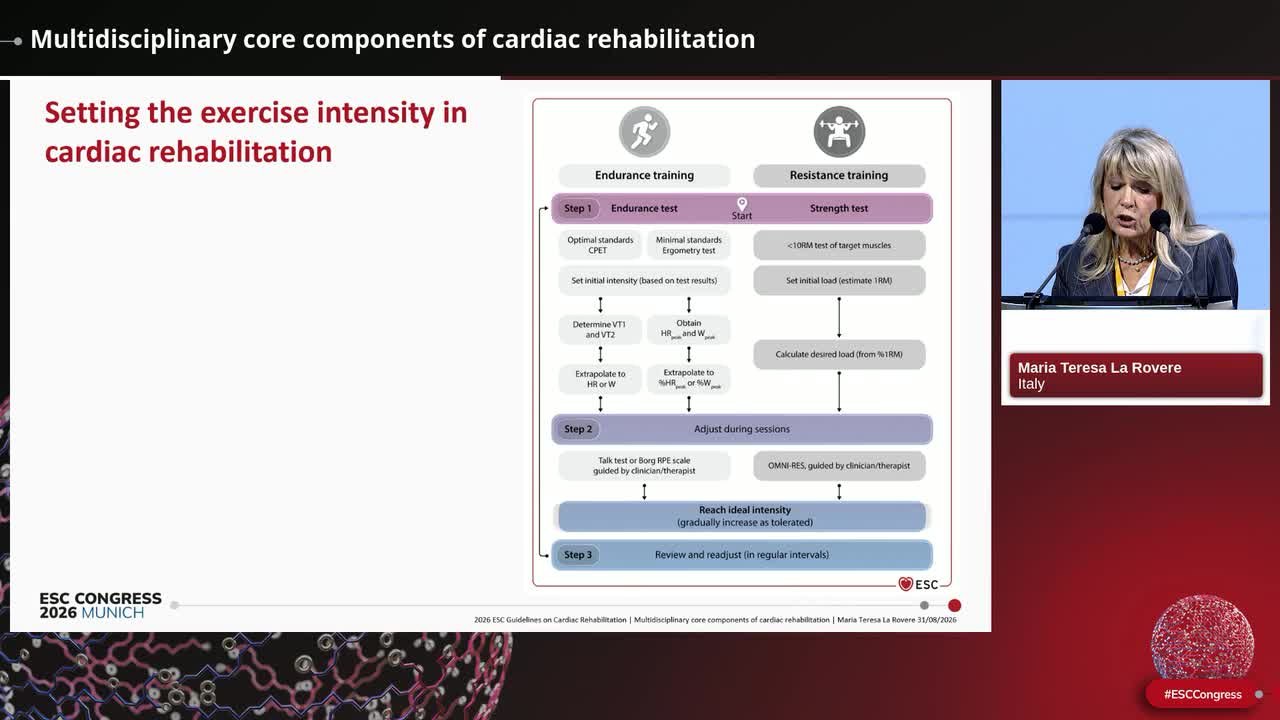
“A major focus of the guidelines is that effective cardiac rehabilitation consists of more than exercise training alone,” notes Associate Prof. Wilhelm. “In the guidelines, we speak of cardiac rehabilitation as a multi-component intervention that also addresses mental health and provides education. Improving health literacy and greater self-management can lead to sustainable lifestyle changes and increased adherence with medical therapies.”
Another major message from the guidelines is that cardiac rehabilitation should be considered a core component of care across a much broader range of cardiac conditions than is often implemented in clinical practice. “In addition to established indications such as ACS and heart failure, the guidelines highlight that patients after surgical or transcatheter aortic valve replacement, with congenital heart disease, with atrial fibrillation or with cancer undergoing potentially cardiotoxic cancer therapies may benefit. Importantly, frailty, older age and comorbidities are not reasons to withhold cardiac rehabilitation,” remarks Prof. Hansen.
There is a strong emphasis on comprehensive patient assessment and individualised, patient-centred care. Cardiac rehabilitation should be tailored to each patient’s medical, functional, psychosocial and lifestyle needs. The guidelines also focus on delivery modes, making the implementation of cardiac rehabilitation more flexible according to the patient’s capabilities and preferences. As such, telehealth, telemedicine and mobile health are discussed in a dedicated chapter, highlighting cardiac rehabilitation as an area where innovation is helping to make great strides in improving the patient experience while working within constrained healthcare budgets.
Some countries in Europe still do not have reimbursement for cardiac rehabilitation and in others, referral rates and attendance are low. [2] With the ageing population and the increasing number of life-years spent with poor physical and mental functioning, rehabilitation implementation and participation is a key. Indeed, the need to improve rehabilitation is recognised in the World Health Organization’s ‘Rehabilitation 2030: A Call for Action’ [3] and is anchored in the EU Safe Heart Plan. [4] In this dynamic and much-needed area of cardiology, the release of the 2026 ESC Guidelines on cardiac rehabilitation is timely, complementing existing recommendations in ESC Guidelines and other ESC scientific documents.
Want to know more? Full details can be found in the European Heart Journal.