Digital transformation in healthcare is not just about adopting the latest technology; it’s about a shared, global commitment to improving patient care.
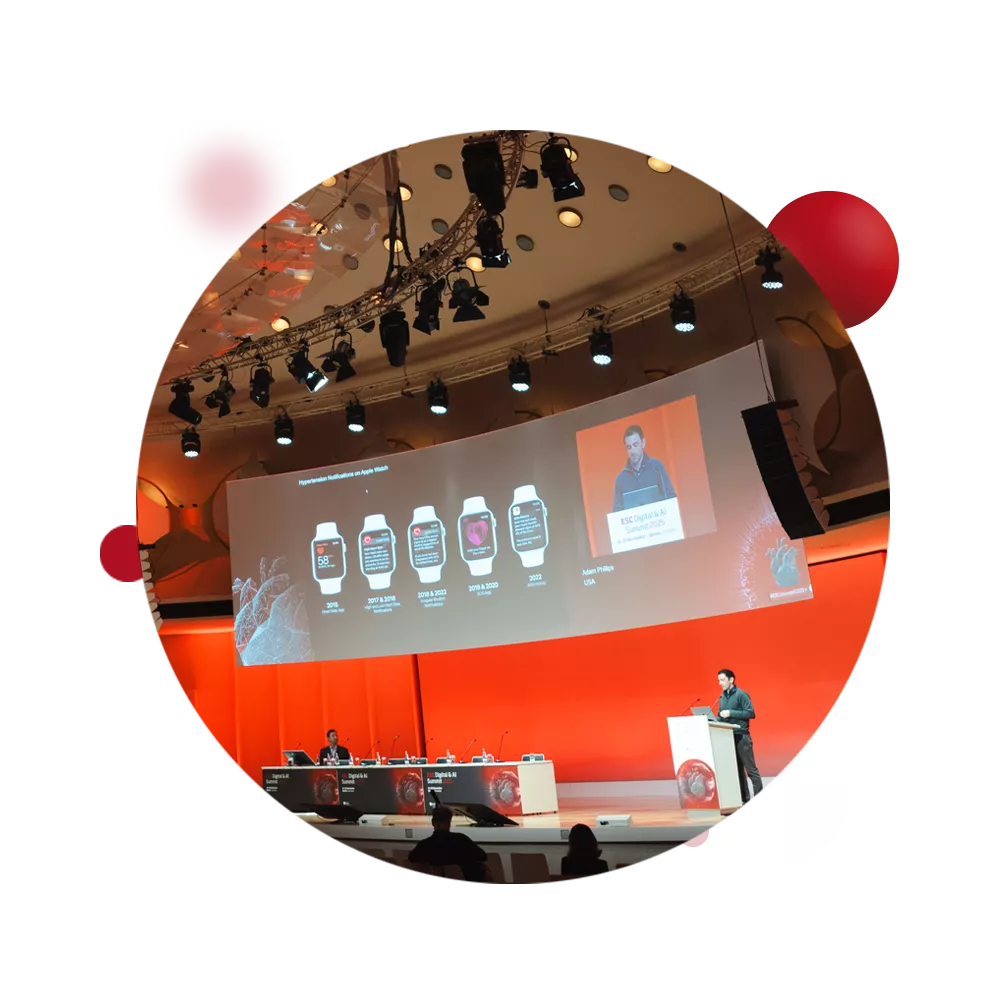
The ESC Digital & AI Summit unites professionals and thought leaders from around the world, all driven by the same mission: to harness digital innovation for life-saving advancements in cardiovascular care.
Get a first glimpse of the Scientific Programme (regularly updated)
Hear from Folkert Asselbergs, Chair of the ESC Digital & AI Committee 2024-2026 and his avatar, as they give you an inside look into the event.

Embrace a new era in digital cardiology
With real-time data insights and AI-powered decision support becoming a part of our practice, the scientific programme will highlight the innovations and how they are accelerating patient outcomes and transforming clinical workflows.
Learn from pioneers, challenge the status quo, and gain the insights you need to stay ahead in this rapidly evolving field.
The programme will allow you to ask your questions to the leading healthcare innovators and technologists in Berlin and explore how these advancements are reshaping the future of patient-centered care.
Prepare for the next frontier in cardiovascular care
What’s next in digital technology? From AI-driven diagnostics to groundbreaking breakthroughs in 5G, robotics, and virtual care, the future is unfolding now.
Together with the experts we will address the challenges of implementing digital health solutions while maintaining ethical integrity.
From roundtable to debate sessions, the scientific programme will highlight digital innovations and AI’s potential to transform cardiovascular diagnosis, treatment, and research.
Roundtable will be the occasion to discuss the ethical, clinical, and practical dimensions of digital health and AI.
Keynote sessions
AI decoded: how researchers, practitioners and clinicians can leverage AI for the future of healthcare, by Max Tschochobei
In this session, we will explore the current AI inflection point in healthcare, how big tech companies are influencing healthcare research, and how researchers can access foundational models. We will demystify core AI and cloud concepts and outline practical steps for training, validating, deploying, and cost-managing AI solutions. We will close with a panel discussion with decision makers and industry leaders from technology and healthcare to discuss the implications of these technologies on the European healthcare ecosystem. Bookmark this session in 'My Programme'.
Max Tschochobei advises enterprise customers how to realize their AI ambitions on Google Cloud. As an engineering leader in Google, he leads teams of data and AI engineers in mission-critical customer projects, developing the next wave of AI agents across industries. While his work includes advisory on all products and solutions in the Google Cloud portfolio, he is especially interested in Agentic AI and Large Language Models, and their applications in the healthcare industry. Before joining Google in Munich, Max spent many years as a consultant with the Boston Consulting Group. He led the digital transformation of NTUC Enterprise, a Singapore-government linked organization that provides retail, banking, insurance, healthcare and education services to Singaporeans. He holds a PhD in Economics and is co-lead of the AI in Women's Health research group at TUM University Hospital in Munich. When he's not coding AI agents, you are likely to find Max on his mountain bike or on hiking trails in the Bavarian Alps.
AI and the future of medicine, by Daniel Rueckert
Over the last decade, Artificial Intelligence (AI) and Machine Learning (ML) techniques have led to significant advances across many areas of society. Recently, deep learning has emerged as a particularly powerful approach for solving different tasks across many application domains, including in medicine and healthcare. This talk will focus on discussing the potential for AI for the personalised diagnosis and prognosis of diseases as well as the prediction of treatment response. In particular, I will show how AI has already transformed the acquisition, analysis, and interpretation of images in cardiology and how frontier AI models and agentic AI can transform other areas in medicine and healthcare. Bookmark this session in 'My Programme'.
Daniel Rueckert is Alexander von Humboldt Professor for AI in Medicine and Healthcare at the Klinikum rechts der Isar, Technical University of Munich, where he is also Director of the Institute for AI and Informatics in Medicine. He is also a Professor of Visual Information Processing in the Department of Computing at Imperial College London. He has worked on developing novel AI methods for the application to problems in healthcare and medicine. A particular focus of his research has been biomedical image computing, covering all aspects from image acquisition to image analysis and interpretation. He has been elected as Fellow of the MICCAI Society (2014), Fellow of the Royal Academy of Engineering (2015), Fellow of the IEEE (2015), Fellow of the Academy of Medical Sciences (2019), Fellow of the European Laboratory for Learning and Intelligent Systems ELLIS (2021), Fellow of the American Institute for Medical and Biological Engineering (2021), Fellow of the German National Academy of Sciences Leopoldina (2023) and Fellow of the Royal Society (2025). In 2024 he received the MICCAI Enduring Impact Award for his contributions to medical image computing. He is recipient of the Gottfried Wilhelm Leibniz Prize (2025), which is the most important German research prize endowed with €2.5M by the German Research Foundation (DFG).
Technology and Innovation
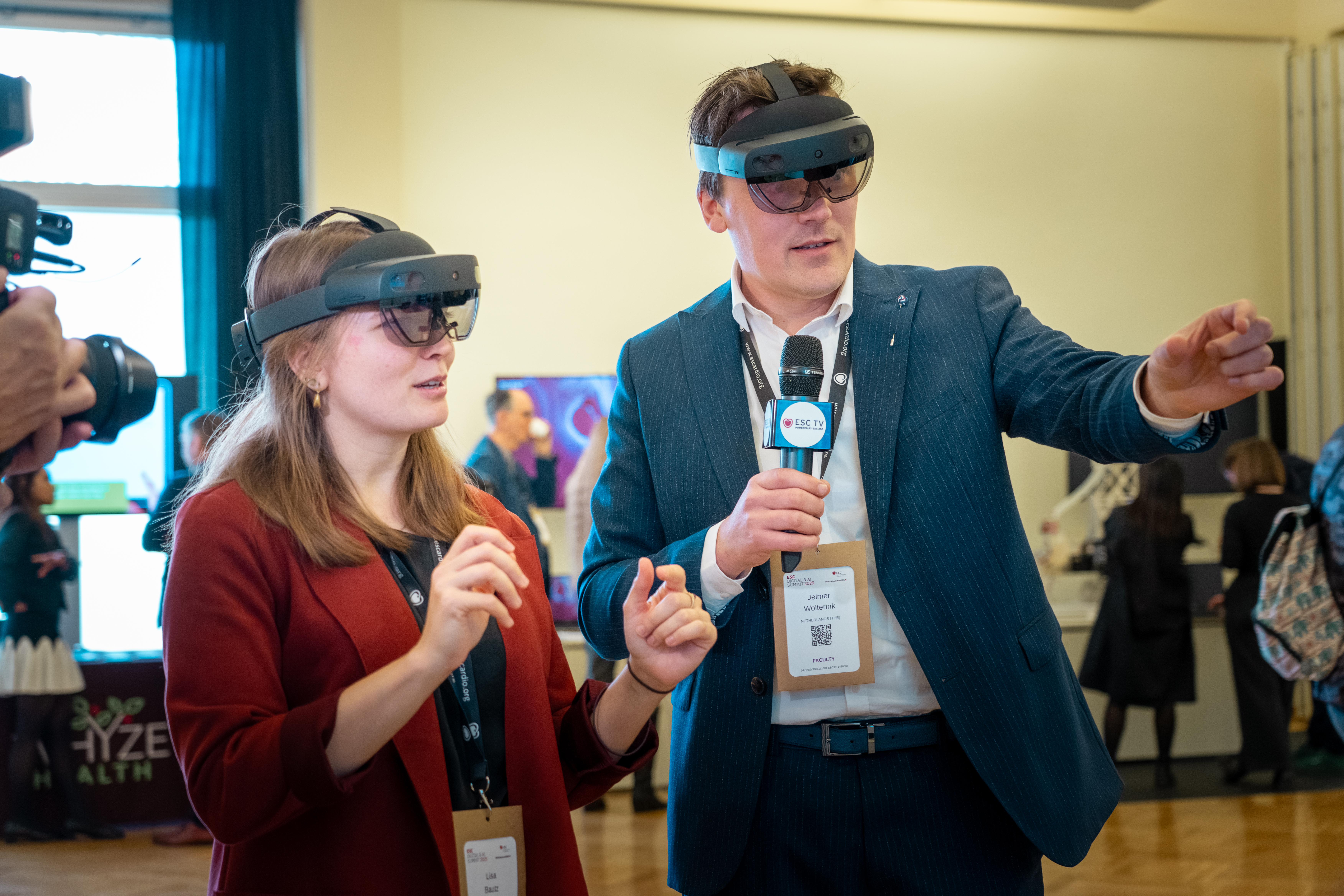
Accepted technology and innovation solutions will be (1) presented on the Digital Stage and (2) Live-demonstrated to the audience in the Technology and Innovation Demo Room.
This is a great opportunity for presenters to showcase their innovative solution and receive feedback from international experts and patients.
Our mission: To reduce the burden of cardiovascular disease.