


The Roman and ancient period
The history of medicine in Italy begins in ancient Rome, where, although it was highly influenced by ancient Greek medicine, new treatments involving, for example, dietary regimens and surgical procedures, were also developed.
Four physicians who worked in and around the Roman Empire have had a particularly long-lasting influence on medicine: Dioscorides, a Roman military physician, Soranus, representative of the Methodic school of medicine, Galen, and Asclepiades.
Aulus Cornelius Celsus was a Roman encyclopaedist living during the reigns of Augustus and Tiberius. The treatise De Medicina is his only surviving work and includes eight volumes, two of which are on surgery. Its contents were considered lost until the 15th century when Pope Nicolas V rediscovered it. In 1478, it became the first medical book published in Florence.
Due to a great many factors, no new knowledge about cardiac anatomy or physiology was produced in ancient Rome beyond the ancient concepts of Hippocrates.
Galen accepted the anatomic and medical principles of the contemporary theory of the four humours, which comprised black bile, yellow bile, blood, and phlegm. Imbalances in these humours corresponded with particular human temperaments.
Galen's major contribution to medicine was his work on the circulatory system, recognising the differences between venous (“dark”) and arterial (“bright”) blood. He erroneously postulated that blood originated in the liver, and that it flowed unidirectionally into the right ventricle of the heart. He also believed that air from the lungs was carried into the left ventricle through the venous artery, and that waste products from the blood were carried from that same venous artery into the lungs, where they were exhaled. He hypothesised the presence of small holes in the interventricular septum that received air from the lungs to be exchanged with the waste products in the left ventricle.
Galen's work on anatomy remained largely unsurpassed and unchallenged up until Mondino de Liuzzi, founder of the Cattedra di Anatomia in Bologna in 1315.
The school of Salerno
The school of Salerno was a turning point: it was the first known medical school in Europe, founded in the 8th century and continuing to evolve through the 12th century.
This school was highly renowned from the last years of the Lombard kingdom until the fall of the Hohenstaufen. In 1077, Salerno received the appellative of the “Town of Hippocrates” (Hippocratica Civitas or Hippocratica Urbs). The sick hoping to be cured as well as students seeking to learn medicine came from all over the world to the Schola Salernitana.
The method of the school was founded on the concept of prevention rather than curing, inaugurating the empirical method in medicine. These concepts came from the synthesis of the Graeco-Latin tradition, supplemented by notions from Arab and Jewish cultures which was facilitated by the geographic location of the town – a Mediterranean port – where Arab and Eastern Roman culture met.
In 1231, the school was further empowered by Federico II who, in his constitution of Melfi, established that medicine could only be practised by doctors with a diploma from the Salernitana Medical School.
A particularity of the school was that it admitted women physicians, known as the “women of Salerno” or the mulieres Saleritanae, of whom Trota, or Trotula de Ruggiero, who wrote treatises on gynaecology and cosmetics (the Trotula), was the most notable representative.
The main fields of medicine studied in the school were anatomy – with frequent practice of animal dissection and the autopsy of human bodies – as well as surgery, and also hygiene and diet.
We have no information from the Salerno medical school about their views on the heart and cardiovascular anatomy, physiology, or their approach to diseases. Although active until November 1811, when it was abolished by Gioacchino Murat, the school began to decline with the creation of newer universities such as those of Padua and Bologna.
The University of Bologna [1,2]
The University of Bologna, founded around 1088 and organised into a university in the last years of the 12th century, is the oldest university in the Western world and the first degree-awarding institution of higher learning.
The University of Bologna was established thanks to a spontaneous initiative of students, who organised themselves in a primitive association to propose their teaching goals and how they should be implemented. Teachers were paid directly and were often accommodated in the students' homes, with whom they maintained family-like relationships.
The university attracted hundreds of young and rich people, who brought with them not only books but also a large amount of funding. Thus, the Commune of Bologna made an inviolable agreement with its Alma Mater Studiorum, supporting, protecting, and favouring it with various laws and decrees.
In the 13th century, the law school were the most respected, but artists/creators also enjoyed a great reputation in their own cultural fields. In the following century, the students’ management bodies assumed a greater degree of control from local and papal authorities, and the teachers and their College of Doctors had to endure the imposition of disciplinary measures, which led to a slow decline.
After the settlement of the Bentivoglio family in Bologna from 1401 to 1506, the town regained its status as a cultural metropolis, ready for the arrival of the Renaissance. This period included notable names such as Leon Battista Alberti and Giovanni Pico della Mirandola, and it saw the University of Artists expanded with schools of Music (the first in Europe), Mathematics and Astronomy (1451), Greek and Hebrew Language and Literature (1453), and Metaphysics (1466), together with a revival of literature, philosophy, and medicine. It was the time of Renaissance humanism. And it was the time of Nicolaus Copernicus, a student of law who would soon turn humanity’s view of the universe upside down.
In 1506, Pope Julius II regained possession of Bologna, which became a bastion of the Counter-Reformation, and the university was reorganised according to its strict principles.
In the early 17th century, after a prosperity-fuelled population boom, Bologna went through a long period of stagnation related to a succession of famines and epidemics. This period nevertheless saw a paradoxical increase in the number of professorships, although the increase in the number of courses was inversely proportional to the quality of the teaching, which was increasingly entrusted to the poor intellectual abilities of certain local nobles who obtained teaching posts despite their lack of skill.
The training of physicians at the University of Bologna began in 1219 with Taddeo Alderotti. A traditional medical education, bound to the theories of Aristotelian and Galenic works, was delivered and imitated by other medical schools.
The faculty of Medicine was greatly improved in the 16th century with the knowledge acquired from the practice of anatomical dissection, which became a relevant part of teaching activities thanks to Mondino de Liuzzi.
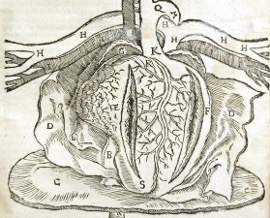
Mondino studied at the College of Medicine and the College of Philosophy of Bologna University, graduating around 1290, and thereafter being employed by the university as a public lecturer in practical medicine and surgery from 1306 to 1324. He was the first to incorporate the systematic study of anatomy and dissection into a medical curriculum, performing his first public dissection in January 1315 in the presence of medical students. His major work, Anathomia corporis humani, written in 1316, is the first example of a modern dissection manual and anatomical text, being printed in Padua between 1475 and 1478. However, in the description of the human heart, there are only three chambers shown: the right ventricle, the left ventricle, and a middle ventricle within the septum. The right ventricle has a large opening, allowing for the entry of blood, which was thought to originate in the liver, into the heart, and the vena arterialis opens toward the lungs. The left ventricle contains an orifice with three valves, and the opening of the arteria venalis has two valves originating from the lungs. The vena cava (vena chili), the course of the pulmonary artery (vena arterialis), and the pulmonary veins (arteria venalis) are all accurately described. His notes about pericardial structure and function and pericardial fluid, which he believed protected the heart, are particularly noteworthy.
Figure 1. Dissection of the heart, from Mondino de Liuzzi's Anatomia Mundini, Ad Vetustis, 1541. (Public domain, via Wikimedia Commons)
Jacopo Berengario da Carpi attended university in Bologna, receiving his degree in medicine in 1489. His publishing record began in 1514 with an edition of Mondino de Liuzzi’s Anatomy and made several important advances in the field of anatomy, including the publication of the first anatomical text augmented by illustrations, and proof of the inaccuracy of Galen's version of the rete mirabile.
Julius Caesar Aranzi (1530–1589) became Professor of Anatomy and Surgery in 1556, establishing anatomy as a major branch of medicine for the first time. Aranzi combined anatomy with pathological processes, thanks to his own research. Aranzi discovered the “Nodules of Arantius” in the semilunar valves of the heart.
Fabrizio Bartoletti (1576-1630) graduated from the school of medicine in 1613 and became a teacher of anatomy in 1619 at Bologna University. He wrote Methodus in Dyspnoeam, published posthumously in 1632, about disturbances in the rhythm and depth of respiratory activity. In this treatise he describes “respiration alterations predicting sudden death” in patients who are unable to walk due to an intense, recurring pain diffused over the chest, with the sensation of an oppressive weight upon the sternum. This seems to be a description of angina pectoris a hundred and fifty years before Heberden’s classic description.
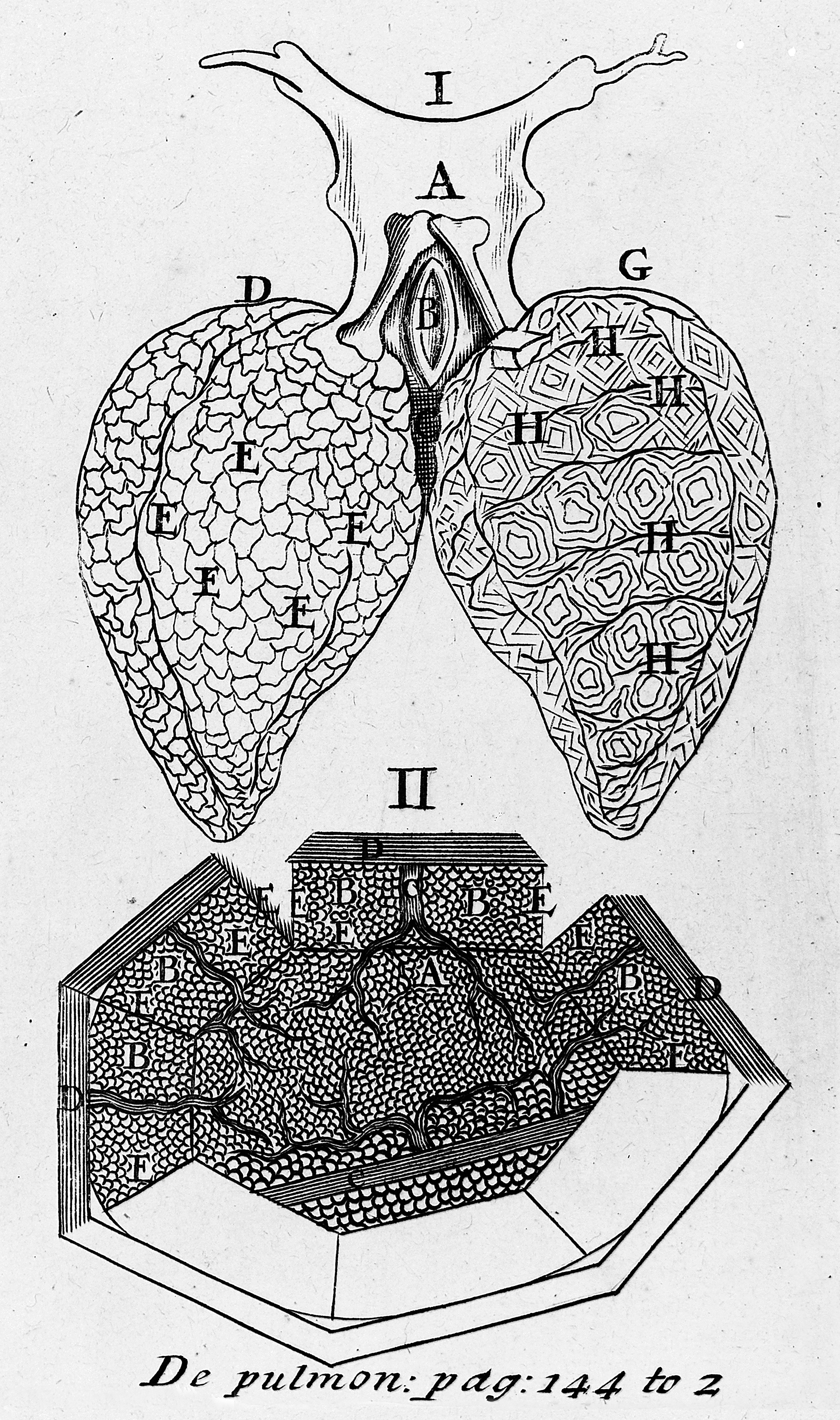
Marcello Malpighi [3], born in 1628, entered Bologna University at the age of 17 and completed grammatical studies there in 1645. Later, he joined the school of anatomy under Bartolomeo Massari and graduated as a medical doctor at the age of 25. He dedicated himself to further study in anatomy and medicine, combining an intense interest in scientific research with a love of teaching. In 1656, he accepted a professorship of theoretical medicine at the University of Pisa, though he would return to the University of Bologna in 1659. In 1661 he described the pulmonary and capillary network, connecting small arteries with small veins. Through the discovery of the capillaries in frog lungs, Malpighi studied the movement of the blood in a contained system, in contrast with the galenic view of an open circulatory system in which blood was thought to come from the liver/spleen and pool into open spaces in the body. His description of capillaries connecting arteries to veins and generating a closed system of circulation in animals contributed to William Harvey’s theory of blood circulation.
Figure 2. Representation of frog lungs with capillary net. Malpighi 1661. (Public domain, via Wikimedia Commons)
Malpighi's medical consultations led to a better understanding of the links between human anatomy, disease pathology, and treatments for diseases, and he used this knowledge to practise what he called “rational” medicine.
Although he accepted temporary chairs at the universities of Pisa and Messina, he often came back to Bologna to practise medicine, and the city repaid him by erecting a monument in his memory.
After the plague of 1668 the radical decision was made to suspend new teaching posts for a period of twenty years. The situation in the late 17th century was dramatic: many local students became indoctrinated with antiquated notions and were loyal to the church. Despite this, in 1690 the Accademia degli Inquieti (Academy of the Restless) was established as a private club which became a meeting place for intellectual exchange and discussion. Later, in 1711, the Academy of Sciences of the Institute of Bologna became famous throughout Europe for its large, international network of scientific exchanges and for the personal and professional relationships developed there between the most illustrious inventors and artists of that time.
Ippolito Francesco Albertini (1662-1738), who graduated from the University of Bologna in 1689, practised at the Hospital of Santa Maria della Morte and taught theoretical medicine beginning in 1699. In his Animadversiones, he described diseases caused by structural irregularities of the heart, such as dyspnoea, pulmonary oedema, pulmonary stasis, and peripheral oedema, and recognised the severe prognosis of patients with generalised anasarca.
Antonio Maria Valsalva (1666–1723) studied medicine under Malpighi and graduated from medical school in 1687. In 1695, he was named surgeon at the Hospital for the Incurables (Sant’Orsola), also in Bologna, and in 1705 he was appointed professor of anatomy; the great anatomist Giovanni Battista Morgagni figured among his pupils. He famously described the aortic sinuses of Valsalva and the Valsalva manoeuvre.
In 1796, Napoleon’s troops entered Bologna, establishing the Cisalpine Republic. In 1802, only the universities of Bologna and Pavia were recognised and made public, and their offerings were limited to three professional departments: Physics and Mathematics, Medicine, and Law. After the Papal Restoration, the university retained its Napoleonic structure, although theological professorships and spiritual exercises were reinstated. In 1824, with the Constitutio qua studiorum methodus of Pope Leo XII, four new departments – Theology, Law, Medicine and Surgery, and Philosophy – were established. In 1860, the people of Bologna voted for their annexation into the Kingdom of Savoy. 1869 saw the inauguration of modern university clinics in the former convent of Sant’Orsola.
In this period in Bologna, the treatises Delle Malattie del Cuore (On Heart Diseases) in 1810 by Antonio Giuseppe Testa, considered the first systematic work on this discipline, and Sui Rumori del Cuore (On Heart Auscultation) in 1837 by Ulisse Breventani, were published. The volumes of Testa contain anamnestic and clinical descriptions, but with many references to previous authors. In Breventani’s auscultation manual, there is abundant description of physical signs and a precise analysis of symptoms, that, despite its errors due to the scarce knowledge of those times, is still admirable.
Bibliography
1. Latronico N. Il Cuore nella Storia della Medicina, 1955 Ed. A. Recordati
2. Bortolotti A. Il Cuore nel Tempo, 1996 Ed. Mediamix
