


Keywords
cardiovascular, Islamic golden era, medical history, Muslim scholars
Take-home messages
- There were revolutionary advances in medicine during the Islamic golden era.
- Muslim scholars such as Rhazes, Avicenna, and Ibn al-Nafis made great contributions to cardiovascular medicine.
- Unfortunately, their work has occasionally been attributed to Western scientists, as can be seen in the case of Ali Ibn al-Abbas al-Majusi's The Complete Book of the Art of Medicine.
- It is time to acknowledge the influence of Muslim scholars and to honour their medical legacy.
Introduction
The Islamic Golden Age (800-1450 CE) is the era in which major advances occurred in both science and economy in the Islamic world. Scientific breakthroughs started with the caliph Haroun Ar-Rasheed (766-809 CE), who created the Baytu Al Hekma (House of Wisdom) in Baghdad, where scientists from all over the world gravitated to translate Roman and Greek scientific works into Arabic.
Muslim physicians did not practice medicine as a profession to earn a living by, as most of them had incomes similar to those of wealthy merchants [1]. Rather, they believed that medicine was “an art of healing”, and treating patients was approached as an art requiring education, training, experience, and dedication.
Muslim physicians not only treated patients, but they created a system through which patients’ rights were respected and preserved. Modern regulatory conventions such as licensing examinations, informed consent, and other ethical considerations were derived from Muslim physicians who practiced medicine during the golden era of Islam [2]. Akhlaq-Al-Tabib (Morals of the physician) by Al-Razi and Adab Al Tabib (Behaviour of the physician) by Ar-Ruhawi laid the foundation for medical ethics and codes of conduct (including social conduct), centuries before Western communities attributed importance to such things [1].
Despite the immense medical knowledge that was advanced and/or created by Muslim scholars, their work is usually overlooked and unrecognised by modern Western communities. In this review, we aim to provide a glimpse at the valuable contributions of Muslim physicians to the field of cardiovascular medicine during the Islamic golden era, where the medical profession surpassed the barriers of religion, language, and country.
Central illustration. Scientists who contributed to the field of cardiology during the Islamic golden era.
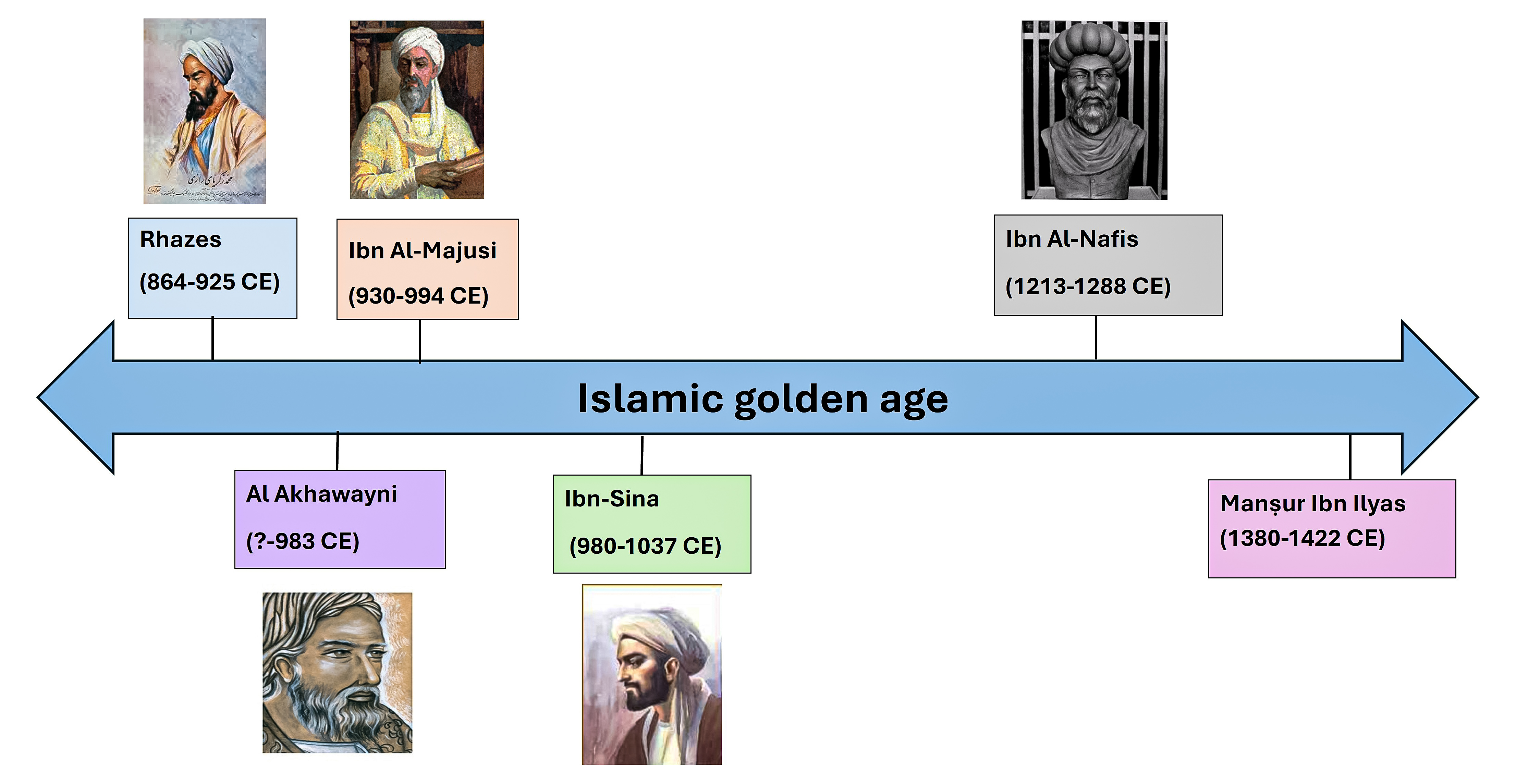
Al-Razi, Rhazes (c. 864-925 CE)
Abu Bakr Muhammad ibn Zakariyya al-Razi, known in Latin as Rhazes, was born in Rayy, a major city near present-day Tehran. He practised gynaecology, obstetrics, and ophthalmology, while maintaining interests in philosophy and mathematics. His nickname was “The father of experimental medicine”, as he performed one of the first recorded clinical trials with a control group when testing bloodletting as a remedy for meningitis [3]. He tested drug toxicity levels on animals before prescribing them, and he pioneered a hierarchical system of clinical teaching involving "circles" of students and the use of detailed case histories, forming a template for modern medical records [4].One of the most famous anecdotes regarding his brilliance concerns the selection of a site for a new hospital: he hung pieces of fresh meat at various locations across Baghdad and chose the site where the meat putrefied the most slowly, reasoning that the air there was the "healthiest" and least polluted [4].
Works
Kitab al-Hawi fi al-Tibb (The Comprehensive Book on Medicine), commonly known in the West as the Liber Continens, and was translated into Latin in 1279 CE. It provided the framework for medical curriculum in European schools until the 14th century. It is a compilation of Al-Razi’s lifelong reading notes and clinical observations, and is his most massive and significant work, in which he emphasises the importance of ethical practice, confidentiality, empathy, and psychological counselling to healing [5].
Kitab al-Mansuri fi al-Tibb (The Book for Mansur), written in 903 CE, served as a concise textbook of medical theory and practice. The ninth chapter, focusing on diseases “from head to toe," became especially famous in Europe as the Liber Nonus [6].
Contributions to the field of cardiology
Al-Razi’s made many pioneering contributions to cardiology, predating Renaissance observations by several centuries
Anatomical description of the heart
Al-Razi provided a detailed look at the heart's structure, being one of the first to clearly identify and describe the auricles [5].
Discovery and function of heart valves
Al-Razi described the pulmonary and aortic valves, noting that their cusps open from "inside to outside," correctly deducing that this orientation allowed blood to exit the heart while preventing its return [5].
The pulse and vascular synchrony
He refined techniques for examining the strength, length, and consistency of the pulse. He specifically linked the "goat-leap" pulse (pulsus gazellans) to the diagnosis of pericarditis [5].
Syncope and "sudden death"
Al-Razi observed that syncope and sudden death were direct consequences of cardiac malfunction, famously stating: "Sudden death takes place when the heart contracts but does not relax" [5].
Ali Ibn al-Abbas al-Majusi (930-994 CE)
Ali Ibn al-Abbas al-Majusi, known in Latin as Haly Abbas, was born in the city of Arrajan in Old Persia, and practised as a physician and a surgeon.
Works
The only known book by Ali ibn Abbas, Kamil al-Sina'ah al-Tibbiyah (The Complete Book of the Art of Medicine), also known as Al-Kitab Al-Maliki (The Royal Book), is a comprehensive work of medicine that systematically and comprehensively describes many medical conditions in a practical style. Plagiarised by Constantinus Africanus of Monte Cassino (c. 1015–1087 CE) in the 11th century, this book, several pages of which are devoted to cardiology, was considered a surgical reference in European medical schools for many years.
Contributions to the field of cardiology
Ali Ibn Abbas described the anatomy of the heart, its position in the chest cavity, its surrounding organs, and its internal structure. He mentioned that the inside of the heart consists of 2 cavities, and he followed Galen’s lead in proposing the presence of fenestrations in the interventricular septum to allow passage of blood from right to left. He thought that the liver was the origin of veins. He described the cardiac valves, noticing that the mitral valve has only two leaflets while the tricuspid and aortic valves have three. In his description of the pulmonary arteries, he mentioned that they are responsible both for transferring blood to the lungs and receiving air from them [7].
In this book, Ali Ibn Abbas illustrates the difference in wall thickness between arteries and veins [7]. He provides a detailed anatomical description of the aorta and its branches, the coronary arteries, and the arteries of the circle of Willis. He describes veins as “non-pulsating vessels” and arteries as “pulsating vessels”, and is considered the first scientist to mention the idea of blood capillaries as foramina connecting arteries and veins [8].
Al-Akhawayni Bukhari (?-983 CE)
Abu Bakr Rabee Ibn Ahmad Al-Akhawayni Bukhari, known in Latin as Joveini, was born in the city of Bukhara in Old Persia. He practised as a physician with a primary interest in neuroscience. His nickname was Abu Hakim (Father of Wisdom).
Works
Hidayat al-Muta'allemin fi al-Tibb (A Scholar's Guide to Medicine), his only known book, is written in Farsi Dari (new Persian), and was compiled in 975 CE. The book describes the physiology of the human body with anatomical illustrations that include the cardiovascular system [9].
Contributions to the field of cardiology
Fi Heya'at al-Ghalb (Discourse on the Anatomy of the Heart) is a subsection of this book in which he describes the anatomy of the heart, including illustrations of the 4 cardiac cavities (2 atria, called Kush in the original text and 2 ventricles), the 4 cardiac valves, and the attached vessels. He notes that the membrane that surrounds the heart consists of 2 layers (now known as visceral and parietal pericardium). He explained that blood goes from the right side of the heart to the left side mainly through pulmonary circulation, but also by small pores in the interventricular septum (which shows the influence of Galen’s theory) [9]. He also provides a detailed description of the right and left coronary arteries.
Ibn Sina, Avicenna (980-1037 CE)
Abu Ali Al-Hussein Ibn Abdullah Ibn Sina, known in Latin as Avicenna, was born in Afshanah, a village near the city of Bukhara in Central Asia (present-day Uzbekistan). His principal domains were clinical practice, pharmacology, and the philosophy of medicine, but he was also interested in philosophy in a broader sense, as well as astronomy and geometry. His nicknames include: "Al Shaikh Al Ra’ees" ("Master Wise Man"), "Prince of Physicians”, "Father of Early Modern Medicine", and "Father of Clinical Pharmacology".
Works
Al-Qanun fi’l tibb (The Canon of Medicine) is an encyclopaedic work that prevailed as an authoritative textbook on medicine for centuries [10]. This book is considered the world’s first medical textbook, in which Ibn Sina combined his own observations with the medical knowledge he acquired from Galen and the philosophy he learned from Aristotle. The eleventh section of the third volume includes descriptions of heart diseases, their diagnosis, and treatment [11].
Al-Urjuzah fi’l tibb (Poems on Medicine) consists of 1,326 verses that simplify and summarise the data in the comprehensive Canon of Medicine.
A book on drugs for cardiovascular medicine, titled Kitab Al-Adwiya al-Qalbiya, is medico-philosophical in nature, that is, philosophy is integrated into medical concepts. In this book, Ibn Sina describes the indications, contraindications, and actions of the drugs used in his time period for the treatment of cardiac diseases.
Resalat-e-Ragshenasi (Treatise on Pulsology) is a Persian treatise in which Ibn Sina details the physiology of pulse, parameters observed in pulse examination, different pulse patterns in various situations, and the effect of an array of diseases and psychological states on the characteristics of the pulse [12].
Contributions to the field of cardiology
Cardiac anatomy
Ibn Sina adopted the Aristotelian version of cardiac anatomy and described the heart as consisting of only 3 chambers: a right, a left, and a middle ventricle [8]. Even so, he correctly described the atrial appendages, the ventricular filling during diastole, and the aortic valve opening during systole (although he believed the 3 cusps of the aortic valve to be 3 valves). Ibn Sina considered the heart to be the source of power and heat for the whole body as well as the organ that controls all other organs, including the brain [10].
He wrote that the heart is protected by a tough covering (the pericardium), and he described the accumulation of fluid in the pericardial sac. He associated the accumulation of fluid with inflammation, palpitation, and fainting, features quite similar to the modern description of cardiac tamponade [10].
Pulsology
Ibn Sina provided the first correct explanation of pulsation, correcting the inaccurate theory proposed by Galen that each organ has its own pulse. Ibn Sina described the pulsation of the heart as a motion of vessels, consisting of two movements and two pauses: expansion, pause, contraction, pause [10]. He showed that the stage of expansion is the movement felt by the physician’s fingers [13].
Ibn Sina described the pulse in 10 parameters (called “ajnas‑al‑nabd”) and was the first to associate pulse rate with psychological well-being. He described 50 pulse types in different diseases, using the pulse as a diagnostic as well as a prognostic factor [11].
Ibn Sina defined a method that is still applied in modern medical practice for the examination of the pulse through the wrist. In fact, he thought that a woman might feel embarrassed if a physician felt her pulse through the chest. Instead, he suggested feeling along the artery with four fingers (excluding the thumb, because it has a strong pulse of its own).
Syncope
Ibn Sina was the first to describe the phenomenon currently known as carotid sinus hypersensitivity when he noticed that, upon compression of the carotid artery, some individuals experience drop attacks accompanied by fatigue, yawning, and flushing [10], a condition similar to what is currently known as neurogenic syncope.
Vascular health
Ibn Sina wrote that when the blood is thin and pure, it flows easily through blood vessels, while thick and impure blood may cause obstruction of vessels. He described the occlusion of blood vessels by local concentrations of what he called “abnormal juices” [14], which might be an early description of atherosclerosis. He also defined myocardial infarction and related its aetiology to arterial occlusion [12].
He proposed a connection between arteries and veins centuries before William Harvey (1578–1657 CE) who is credited as being the first to describe capillary circulation in modern medicine. The proof Ibn Sina provided of the presence of a connection between arteries and veins is that when a vein is cut, blood empties from both [15].
Ibn Sina described the circle of Willis in the brain and defined stroke, relating its aetiology to being “overcome” by blood or a disturbance in certain organs. He divided strokes into 3 phases (acute, subacute, and chronic) and described available remedies in detail [12].
Preventive cardiology
Ibn Sina pioneered the field of preventive cardiology, relating certain diseases to excessive and unhealthy eating, for which he recommended moderation in the quantity and modification of the quality of diet. He also suggested that good digestion is key for good cardiac health. In addition, he stressed the importance of exercise and psychological therapy in alleviating cardiac diseases [13].
Pharmacology
Most of the drugs mentioned in Kitab Al-Adwiya al-Qalbiya were derived from his own experimental medicine [16]. He classified drugs into 83 simple and 17 compound medications and described the form, dose, and application of each one in detail. The efficacy of some of the drugs he mentioned has recently been recognized (e.g., he used a drug called “Zarnab” for relaxing the heart which was recently discovered to have a calcium channel blocking effect) [16].
Ibn al-Nafis (1213-1288 CE)
Ala al-Din Abu al-Hassan Ali Ibn Abi-Hazm al-Qarshi al-Dimashqi was born in Damascus, in present-day Syria. He practised anatomy, urology and ophthalmology but was also interested in philosophy, theology, and Islamic law.
Works
In his seminal work, Sharh Tashrih al-Qanun, a commentary on the subject of anatomy in Avicenna's Canon, Ibn al-Nafis established himself not as a mere commentator, but as a bold critic with a revolutionary empirical vision [17].
He also wrote Al-Shamil fi al Tibb (The Comprehensive Book on Medicine): an ambitious medical encyclopaedia that, at a projected 300 volumes, remains one of the largest medical works ever attempted by a single author [18].
Contributions to the field of cardiology
For 1,300 years, Western and Islamic medicine were dominated by the teachings of Galen, who asserted that blood passed from the right ventricle to the left ventricle through invisible pores in the interventricular septum in order to be "vitalised”. Galen described the septum as a sponge-like structure that allows blood to seep through to meet the "vital spirit" in the left heart [2].
Ibn al-Nafis utilised logical deduction and anatomical observation to posit three groundbreaking claims that form the basis of pulmonary circulation [17]:
- The septum is solid: Ibn al-Nafis argued that the interventricular septum is one of the heart's densest and thickest regions. He explicitly stated: "There is no passage between these two cavities; for the substance of the heart is solid in this region and has neither a visible passage... nor an invisible passage... as was thought by Galen".
- The pulmonary path: since the septum is impermeable, he reasoned that the entire volume of blood must flow from the right ventricle through the pulmonary artery (which he termed the "arterial vein") to the lungs.
- Aeration and refinement: He described the lungs as porous organs where blood spreads through fine branches to mix with air. This "refined" or "thinned" blood then returns via the pulmonary vein to the left ventricle to be distributed as "vitalised" blood.
While Galen believed the arteries possessed a "pulsative faculty" inherent in their walls — essentially, that the arteries expanded independently of the heart to "inhale" cooling air, Ibn al-Nafis redefined the pulse as a secondary mechanical event. He argued that the expansion of the artery was a direct result of the heart’s contraction forcing blood into the vessel [2].
One of his most sophisticated observations was the rejection of "simultaneity." Galenists thought that the entire arterial tree expanded at the same moment. Ibn al-Nafis, through careful tactile observation, argued for sequential expansion. He theorised that the aorta expanded first, followed by larger arteries, and finally the peripheral vessels. His recognition of a temporal delay in pulse propagation was centuries ahead of his time [19].
Ibn al-Nafis proposed the concept of a "natural volitional motion" of an artery. He believed that after the heart forced blood into the artery, the artery had to contract to prevent the formation of a vacuum. While we now attribute this to the elastic fibres (elastin) in the tunica media and the "Windkessel effect," Ibn al-Nafis was the first to attempt a mechanical, rather than a mystical, explanation for arterial recoil [17].
Ibn al-Nafis made a second major discovery: the coronary circulation. He recognised that the heart is a muscle requiring its own dedicated nutrient supply, correctly pointing out that the heart is nourished by vessels — the coronary arteries — that permeate its own substance [19].
Manṣur Ibn Ilyas (1380-1422 CE)
Mansur ibn Muhammad ibn Ahmad ibn Yusuf ibn Ilyas, known in the West as Ibn Ilyas, was born in Shiraz in Southern Iran and practised as an anatomist, surgeon, and physician.
Works
His Tashrih-i Mansur-i (Mansur's Anatomy) is the first colour-illustrated anatomy book in medicine. The book includes full-page illustrations of bones, muscles, nerves, arteries, and veins. It also includes the anatomy of organs such as the heart and brain [20].
Contributions to the field of cardiology
In addition to description of the anatomy of the heart and pericardial membrane, Ibn Ilyas demonstrated that the arterial wall consists of 2 layers: an internal layer showing circumferential fibres, and an external layer showing longitudinal and oblique fibres [8]. He argued that the heart is the first organ to form in the embryo, unlike Hippocrates, who proposed the brain.
Conclusion
The history of cardiology is a continuous thread of human inquiry. In the Islamic golden era, Muslim scholars adopted, adapted and sometimes established evidence-based theories related to different medical fields, including cardiovascular medicine. By recognising their work, we acknowledge their legacy and the revolutionary role they played which paved the way for the progress of modern medicine.


