


Hypertrophic cardiomyopathy (HCM) has come to the foreground of translational research in recent years, with first-in-class myosin inhibitors and gene therapy options emerging as therapeutic options. These developments have been driven by a strong focus on preclinical research and model systems to develop and test these therapies. Given the sustained interest in HCM, we decided to systematically study the strengths and limitations s of the different preclinical models. To our knowledge, this is the first comprehensive overview of all experimental models to study HCM.1 Noteworthy, many papers fail to describe relevant hallmark characteristics of HCM in their models, with rates of 21%, 25% and 12% for mouse, cat and iPSC-CMs models, respectively, which makes it difficult to judge if a model is suited for future studies (Table 1). This lack of reporting can be partly explained by our systematic review method as hallmarks (impaired relaxation, hypertrophy, and (pro-)arrhythmias) were not included when no statistics were applied. In addition, some studies relied on data from previous research without independent validation. Though even taking these factors into account, underreporting of relevant HCM data in disease models remains high. Moreover, the quality assessment and risk of bias scores were low, and key factors such as breed/strain, zygosity, age, and sex, which can significantly influence model outcomes, were inconsistently reported. Unfortunately, over the years, reporting of breed/strain, sex, age, and matching groups did not shown improvement (Table 2). Furthermore, while 93% of all papers on mice reported the average number of mice used in the experiments, calculated power to justify the number of mice was mentioned in only 3% of papers. Details regarding the number of cells studied, e.g., the number of cells per mouse, were often incomplete. Similar issues were observed with iPSC-CMs, where it was difficult to determine the sample size per well, measurement, differentiation, clone, and cell line. On a positive note, the reporting of animal testing regulations and conflicts of interest increased significantly from 42.9% and 0% in 1995-1999 to 95% and 98% in recent years for mouse models (Table 2). Even though this systematic review focused on HCM, the lack of reporting data, without assuming bad intentions such as selective reporting or scientific fraud, is acknowledged as a general problem worldwide.2-7
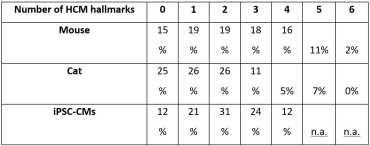
Table 1
Percentage of HCM hallmarks described in papers, including impaired relaxation, cardiomyocyte hypertrophy, disarray and arrhythmias for mouse, cat and iPSC-CMs, and cardiac hypertrophy and fibrosis for mice and cats. The total number of papers analyzed for mouse, cat, and iPSC-CMs models were 304, 95 and 58, respectively.
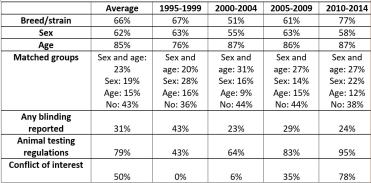
Table 2
The table presents seven parameters from the risk of bias and quality assessment of mouse models, categorized into 5-year time periods, to identify any changes observed over time.
Why is it important to report data?
Basic, crucial details are often lacking from publications, which has a significant impact. Firstly, sufficient information must be provided so that readers (e.g., editors, reviewers, researchers, stakeholders investors, and governments) can evaluate and assess how experiments were conducted. Missing data make it difficult to explain differences between studies, and information is essential for determining future studies, safety assessments, or policy decisions. Moreover, transparency and methodological rigor are necessary to enhance robustness and reproducibility, a growing concern in research.8-11 Studies that cannot be relied upon or replicated waste time, financial resources and materials. Overall, the absence of data raises concerns about the reliability and reproducibility of studies, undermining their validity and translational value.8-12
Why is data not reported?
Is the issue a result of limited awareness and understanding of which data need to be reported, or is it the inherent complexity of reporting requirements? The pressure to publish creates a research environment where novelty and impact are often prioritized over quality and rigor. Sometimes, journals impose constraints on article length, which can lead to less rigorous reporting of methods and data. Additionally, limited awareness and understanding of reporting standards may cause authors to overlook the importance of thorough and accurate reporting.13
Community
Nevertheless, significant effort from the research community has been dedicated to guiding researchers in properly reporting their methods and data. Notable examples are the Animal Research: Reporting of In Vivo Experiments (ARRIVE) guidelines14,15 and Reporting In Vitro Experiments Responsibly (RIVER) guidelines,16 developed by the NC3Rs Reporting Guidelines Working Group for animal studies and cell-based studies, respectively. Other guidelines relate to planning experimental procedures (PREPARE),17 design and statistical analysis,18 randomized trials,19,20 Good Laboratory Practice,21 and the use of stem cells.22-25
Since the first edition of the ARRIVE guidelines, published in 2010, their impact on the research community can be assessed. As mentioned previously, the reporting of breed/strain, sex, age, and matching of groups has not shown improvement over the years for HCM models.1 Interestingly, articles published between 2010-2015 tend to have a lower compliance rate with the parameters addressed in the ARRIVE guidelines compared to those published between 2016-2020.26 Journals that explicitly mention the need for ARRIVE compliance in their author instructions reported a slight but still significant increase in compliance rate, even higher than the general trend observed for 2016-2020.26 Evidences suggest that the compliance rates can be further improved if journals mandate the use of short checklists, such as the “Essential 10” from the ARRIVE guidelines, rather than requiring completion of the full ARRIVE checklist.6,7,27,28 An important finding is that collaborative efforts have improved reporting compliance. For example, articles with seven or more authors demonstrate higher compliance rates with the parameters addressed in the ARRIVE guidelines compared to articles with fewer authors.26 This indicates that engaging with co-authors can enhance overall reporting quality and accountability.
Journals
The reporting of animal testing regulations and conflicts of interest has significantly improved over time.1 As mentioned above, some journals have recognized the problem and taken initiatives to improve reproducibility.7,9 For example, Circulation research published an editorial in 2017 introducing new initiatives.32 Evidence shows that journals supporting the ARRIVE guidelines have higher compliance rates for data reporting in regards to the parameters highlighted in the ARRIVE guideline.26 The ARRIVE guidelines website provides a list of supporting journals, such as Cardiovascular research, Circulation research, and Nature.
In the context of cell-based studies, initiatives exist to promote general use of guidelines.23 However, unlike the ARRIVE guidelines, no journal has yet mandated these quality control guidelines. Stem Cell Research lab resources enable research groups to report the development of new cell lines using a structured format, which includes mandatory reporting of materials in various registries. This approach promotes standardization and improves findability for the research community, aligning with the FAIR (Findability, Accessibility, Interoperability, and Reusability) principles.
Conclusion
We hope that our SR helps scientist to choose a HCM model that is best suited to answer their research questions, and with this editorial we aim to emphasize and highlight the need to improve the reproducibility and reliability of studies, demonstrating a consensus among various guidelines for animal and cell-based research. A hopeful focus for improving research reproducibility is education, particularly training the next generation of scientists in experimental design, execution, and data presentation. Equipping junior researchers with the knowledge of rigorous reporting practices and the tools to implement them will ensure a stronger understanding of research standards. Strengthening education initiatives will foster a culture of transparency and methodological rigor in future research.

Note to editors
References
- van den Dolder, F. W., et al. Experimental Models of Hypertrophic Cardiomyopathy: A Systematic Review. JACC: Basic to Translational Science (2025). https://doi.org/10.1016/j.jacbts.2024.10.017
- Baker, M. 1,500 scientists lift the lid on reproducibility. Nature 533 (2016).
- Errington, T. M., Denis, A., Perfito, N., Iorns, E. & Nosek, B. A. Challenges for assessing replicability in preclinical cancer biology. Elife 10 (2021). https://doi.org/10.7554/eLife.67995
- Kilkenny, C. et al. Survey of the quality of experimental design, statistical analysis and reporting of research using animals. PLoS One 4, e7824 (2009). https://doi.org/10.1371/journal.pone.0007824
- Avey, M. T. et al. The Devil Is in the Details: Incomplete Reporting in Preclinical Animal Research. PLoS One 11, e0166733 (2016). https://doi.org/10.1371/journal.pone.0166733
- Hair, K., Macleod, M. R., Sena, E. S. & Collaboration, I. I. A randomised controlled trial of an Intervention to Improve Compliance with the ARRIVE guidelines (IICARus). Res Integr Peer Rev 4, 12 (2019). https://doi.org/10.1186/s41073-019-0069-3
- Ramirez, F. D. et al. Methodological Rigor in Preclinical Cardiovascular Studies: Targets to Enhance Reproducibility and Promote Research Translation. Circ Res 120, 1916-1926 (2017). https://doi.org/10.1161/CIRCRESAHA.117.310628
- Prinz, F., Schlange, T. & Asadullah, K. Believe it or not: how much can we rely on published data on potential drug targets? Nat Rev Drug Discov 10, 712 (2011). https://doi.org/10.1038/nrd3439-c1
- Begley, C. G. & Ioannidis, J. P. Reproducibility in science: improving the standard for basic and preclinical research. Circ Res 116, 116-126 (2015). https://doi.org/10.1161/CIRCRESAHA.114.303819
- Goodman, S. N., Fanelli, D. & Ioannidis, J. P. A. What does research reproducibility mean? Sci Transl Med. 8 (2016).
- Open Science, C. PSYCHOLOGY. Estimating the reproducibility of psychological science. Science 349, aac4716 (2015). https://doi.org/10.1126/science.aac4716
- Sherwin, C. M. Animal welfare: reporting details is good sciene. Nature 488 (2007).
- Reichlin, T. S., Vogt, L. & Wurbel, H. The Researchers' View of Scientific Rigor-Survey on the Conduct and Reporting of In Vivo Research. PLoS One 11, e0165999 (2016). https://doi.org/10.1371/journal.pone.0165999
- Kilkenny, C., Browne, W. J., Cuthill, I. C., Emerson, M. & Altman, D. G. Improving bioscience research reporting: the ARRIVE guidelines for reporting animal research. PLoS Biol 8, e1000412 (2010). https://doi.org/10.1371/journal.pbio.1000412
- Percie du Sert, N. et al. The ARRIVE guidelines 2.0: Updated guidelines for reporting animal research. PLoS Biol 18, e3000410 (2020). https://doi.org/10.1371/journal.pbio.3000410
- Group, R. W. Reporting In Vitro Experiments Responsibily - the RIVER Recommendations. (2023).
- Smith, A. J., Clutton, R. E., Lilley, E., Hansen, K. E. A. & Brattelid, T. PREPARE: guidelines for planning animal research and testing. Lab Anim 52, 135-141 (2018). https://doi.org/10.1177/0023677217724823
- Festing, M. F. & Altman, D. G. Guidelines for design and statistical analysis of experiments using laboratory animals. ILAR J 43, 244-258 (2002).
- Moher, D., Schulz, K. F. & Altman, D. G. The CONSORT statement: revised recommendations for improving the quality of reports of parallel-group randomised trials. The Lancet 357, 1191-1194 (2001). https://doi.org/10.1016/s0140-6736(00)04337-3
- Schulz, K. F., Altman, D. G. & Moher, D. CONSORT 2010 Statement: updated guidelines for reporting parallel group randomised trials. BMJ (2010).
- Macleod, M. R. et al. Good laboratory practice: preventing introduction of bias at the bench. Stroke 40, e50-52 (2009). https://doi.org/10.1161/STROKEAHA.108.525386
- Geraghty, R. J. et al. Guidelines for the use of cell lines in biomedical research. Br J Cancer 111, 1021-1046 (2014). https://doi.org/10.1038/bjc.2014.166
- ISSCR. ISSCR Guidelines for Stem Cell Research and Clinical Translation. (2021).
- Zhang, Y. et al. Requirements for human-induced pluripotent stem cells. Cell Prolif 55, e13182 (2022). https://doi.org/10.1111/cpr.13182
- Sullivan, S. et al. Quality control guidelines for clinical-grade human induced pluripotent stem cell lines. Regen Med 13, 859-866 (2018). https://doi.org/10.2217/rme-2018-0095
- Emre AydingÖZ, S., Efe, O. E. & ÇaliŞKan, G. Reporting quality of animal studies published in journals listed in ULAKBIM TR index: a systematic review on compliance to the ARRIVE guidelines. Journal of Research in Pharmacy 26(4), 704-713 (2022). https://doi.org/10.29228/jrp.168
- group, N. C. Did a change in Nature journals' editorial policy for life sciences research improve reporting? BMJ Open Sci 3, e000035 (2019). https://doi.org/10.1136/bmjos-2017-000035
- Han, S. et al. A checklist is associated with increased quality of reporting preclinical biomedical research: A systematic review. PLoS One 12, e0183591 (2017). https://doi.org/10.1371/journal.pone.0183591
- Bolli, R. New Initiatives to Improve the Rigor and Reproducibility of Articles Published in Circulation Research. Circ Res 121, 472-479 (2017). https://doi.org/10.1161/CIRCRESAHA.117.311678