


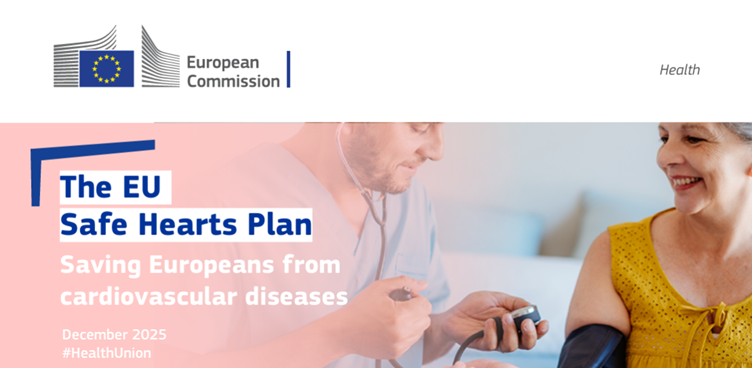
On 16 December, the European Commission approved the EU Cardiovascular Health Plan, 'Safe Hearts'. The ESC welcomes its comprehensive approach to improving heart health across Europe.
The Plan focuses on reducing inequalities, strengthening prevention, and harnessing digital innovation, with concrete actions to be taken at European and national levels. It stands on three strategic pillars:
- Prevention: Revision of tobacco control legislation; levies on ultra-processed foods/beverages containing high levels of salt, fat or sugar; and support for Member States in developing national cardiovascular health plans.
- Early Detection and Screening: Advancing timely identification of at-risk individuals through harmonised protocols, mobile outreach, and digital tools.
- Treatment and Care: Improving access to integrated, person-centred care, rehabilitation, and innovative therapies, while addressing persistent inequalities.
The publication marks the end of a long advocacy campaign, working with ESC members and national societies, alongside a wide range of other stakeholders, and European Commission officials. But, while this is the conclusion of an important chapter for cardiovascular care in Europe, it also marks the beginning of a new one.
Implementation through collaboration
As we look to 2026 and beyond, let’s take this opportunity to maximise the impact of the Plan by ensuring its implementation across Europe. To do this, all stakeholders must work together to turn ambition into action at national, regional and local levels.
Developing national cardiovascular health plans
As part of the new EU Cardiovascular Health Plan flagship initiative on prevention, all Member States will be supported in developing or implementing national cardiovascular health plans by 2027. The European Commission will put forward actions to help countries achieve this goal.
A number of EU Member States already have national plans or strategies in place. The ESC and national cardiac societies have played an influential role in the development of plans in several countries. This year, the ESC Advocacy Bulletin has put the spotlight on the creation of national plans in Romania, Denmark, Czechia and Italy, among others.
While there is no one-size-fits-all template for devising and rolling out a plan, the experience of national organisations can provide valuable insights – not only on the content of the plan itself, but on how to overcome logistical roadblocks on the way to implementation.
With the 2027 target coming fast over the horizon, there is no time to lose. The ESC stands ready to lend its support to countries as they ramp up efforts at national level.
EACH Summit stresses power of partnership

The European Alliance for Cardiovascular Health (EACH) held its annual summit in Brussels on 10–11 December, ahead of the publication of the new EU Safe Hearts Plan. The event brought together 40 speakers from 20 countries, tackling a wide range of topics from health inequalities and the role of patient voices in shaping policy, to gender differences in cardiovascular health and the value of collaboration across the cardiovascular community.
For policymakers, clinicians, researchers, patient advocates and industry, the Summit came at a crucial moment. It featured a keynote address from Olivér Várhelyi, European Commissioner for Health and Animal Welfare, who spoke about the Commission’s vision for cardiovascular health and the opportunity presented by the Safe Hearts Plan.
"Successful implementation can only be achieved through robust, long-term funding," Commissioner Várhelyi said. "A micro-levy on unhealthy food, following the polluter pays principle, will help mitigate the impact of CVD on society and finance the EU Cardiovascular Health Plan."

The EACH welcomed the Commissioner's commitment and pledged to work tirelessly to translate this vision into concrete, lasting improvements for citizens across Europe. Speakers put the spotlight on rising obesity rates, environmental risk factors and disparities in access to care, but there was broad agreement that the new Plan brings potential for lasting change.
"Europe has a unique opportunity, a golden hour, in which to take the lead," said Thomas F. Lüscher, President, European Society of Cardiology.
Looking ahead to 2026
This year will go down as a momentous one for cardiovascular care in Europe. However, the long-term impact of the work done in 2025 will depend on how the EU Cardiovascular Health Plan is implemented in the years ahead.
At the ESC we are committed to doing all we can to support a vigorous and active effort across Europe to ensure every patient benefits from the collective effort that has taken us to where we are today. We hope you’ll join this push for full implementation of the Plan wherever you are.