How to measure the QT interval?
Diagnosis of long QT syndrome (LQTS) is based on either a prolonged rate corrected QT interval (QTc) on repetitive ECG’s in the absence of QT prolonging drugs or ion disturbances, a Schwartz score ≥3.5 or presence of a pathogenic variant in a LQTS causing gene.1 Measuring QTc might sound easy, but is in fact a challenging task. It was shown that world-renowned LQTS experts measure the QTc interval in LQTS patients with a variation up to 70 ms.2
Measurement itself
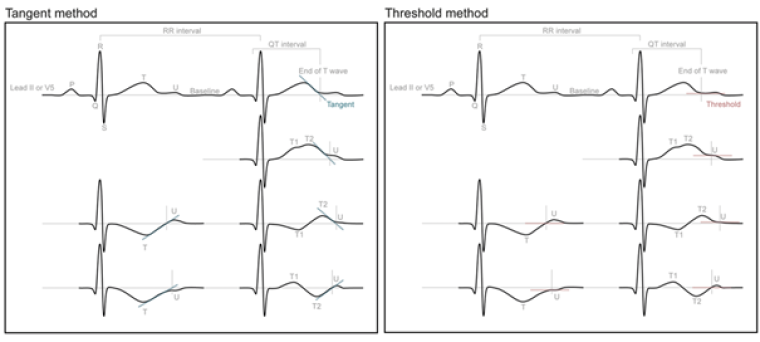
The QT interval is defined as the interval between the onset of QRS and the end of the T wave. Manual measurement of the QT interval is advised over automated measurement, as these automatic assessments struggle with aberrant T wave patterns often observed in LQTS patients resulting in high variation between manual and automated measurement.3 The end of the T wave can be measured by 2 different methods (figure 1).4 The first method is called the tangent method and is defined as the intersection of a tangent to the steepest slope of the last limb of the T wave and the isoelectric baseline, defined as the voltage at QRS onset. The second method is called the threshold method and is defined as the intersection of the terminal limb of the T wave with the isoelectric baseline. The tangent method usually results in a 10ms shortening of QTc compared to the threshold method.4 LQTS patients often show pronounced T wave morphology abnormalities complicating the measurement. Biphasic T waves should be included in the measurement, while U waves should be excluded. Measurements are preferentially done in lead II or V5.
Because there is no gold standard against which these 2 measurement methods can be compared with, it remains uncertain which method is preferable. It has been shown that the Tangent method is easy to learn and is therefore likely to be more reproducible between different physicians.5 However, it could miss the last part of repolarization leading to an underestimation of the QTc. Therefore, among experts there is still no consensus on which should be the preferred method.