You're in the right place! Welcome to our newly updated ESC website.
Start exploring or use our powerful new search engine to find what you need. 

Overview of Cardiac Rehabilitation (OCRE) in ESC Member Countries

Highlights and comparisons of phase II programmes according to the “Country of the Month” reports of National CVD Prevention Coordinators

The importance of cardiac rehabilitation (CR): The WHO report “Rehabilitation 2030: A Call for Action” (1) demonstrated the importance of developing CR as a normal part of the treatment pathway of heart disease patients and highlighted the need to strengthen rehabilitation in health systems to meet the existing and future needs of populations. Topic(s): Rehabilitation and Sports Cardiology

Acknowledgement:

This overview of CR in Europe was prepared by:

Photo
Doctor Jorge Ruivo

EAPC Prevention Implementation Cttee Young Community representative

Photo
Professor Joep Perk

Past EAPC Prevention Implementation Cttee Deputy-Chair (deceased 2022)

Photo
Professor Paul Dendale

EAPC Honorary President

Photo
Professor Ana Abreu

EAPC President 2024-2026

Highlights and comparisons of phase II programmes

In this overview section on cardiac rehabilitation (CR) the reader may find a valuable source of information and inspiration based on the work of the National CVD Prevention Coordinators from ESC member countries. 

The aim:

  1. to broadly compare the national CR phase II services
  2. to reveal contrasting strategies
  3. to describe features unique to certain countries

This was accomplished in two parts:

  • The first part (2017) was derived from the synthesis of 28 "Country of the Month" reports. It extensively describes phase II programmes in Europe, however because of the open format of the reports, not every topic was represented in all countries.
  • The second part (2019) originated from the results of an online survey sent to the National CVD Prevention Coordinators of ESC member countries. Answering all 13 hot CR topic questions was mandatory to allow a full set of data for comparison.

Hopefully, this summary allows you to feel the pulse of CR in Europe as a whole and highlights successful measures that could be generalised as much as possible.

There are many lessons to be learnt! 

Part 1: Country of the Month reports 

This part is divided into six major topics, with more detailed information from specific countries under each topic:

  1. For whom is cardiac rehabilitation indicated? - The patient
  2. Which CR programme is provided? - The programme
  3. By whom is the CR programme conducted? - The team
  4. Where is the programme offered? - The centre
  5. What is the quality? - The outcome
  6. The plans for the future - The future

Read more


Part 2: Online survey (13 core questions)

An online survey was sent to National CVD Prevention Coordinators of 51 ESC member countries (82% participation rate) to cover important demographic, structural and quality control topics:

  1. Cardiovascular prevention and rehabilitation guidelines followed
  2. Major barriers to the implementation and use of cardiovascular prevention and rehabilitation guidelines
  3. Implementation of guidance documents
  4. CR phase II uptake rate after myocardial infarction
  5. CR phase II dropout rate after myocardial infarction
  6. CR phase II average start time after myocardial infarction
  7. CR phase II average duration of the programme after myocardial infarction
  8. Percentage of CR phase II national programmes which rely on inpatient/residential services after myocardial infarction
  9. National percentage of phase II CR programmes which are medically coordinated by a cardiologist
  10. CR mandatory rotation in cardiology training
  11. Percentage of CR programmes mainly provided by public funding
  12. National accreditation program for licensing CR programs
  13. National CR electronic database registry

Presentation of the results

Note: if you would like to use this presentation, please make sure you refer to the source of the data in your acknowledgement: "Overview of Cardiac Rehabilitation in ESC member countries", EAPC Prevention in your Country section.


Presentation of the results

Note: if you would like to use this presentation, please make sure you refer to the source of the data in your acknowledgement: "Overview of Cardiac Rehabilitation in ESC member countries", EAPC Prevention in your Country section (www.escardio.org/EAPC).

OCRE 3.0_presentation_kit2019_Final.pdf (PDF)

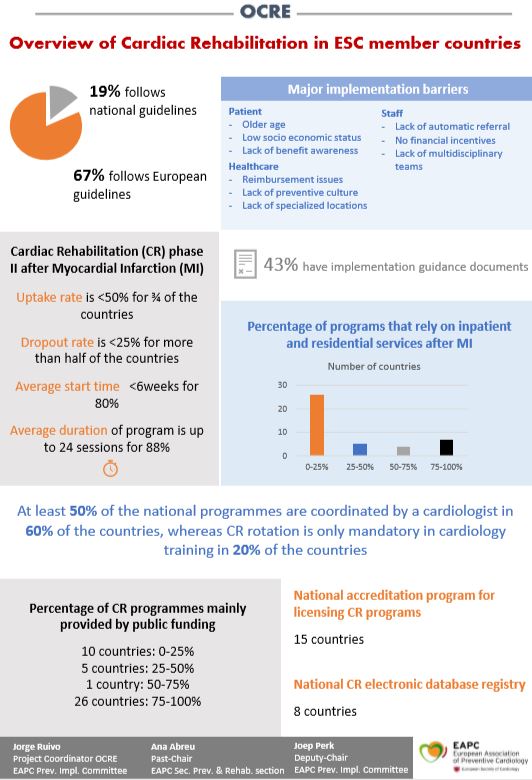
Infographic

Graphical summary of the key findings:

Download PDF

Infographic OCRE FINAL.pdf (PDF)

Published results

Overview of Cardiac Rehabilitation following post-acute myocardial infarction in European Society of Cardiology member countries
Jorge Ruivo, Trine Moholdt, Ana Abreu
European Journal of Preventive Cardiology, https://doi.org/10.1093/eurjpc/zwad024


Note: The content of this article reflects the personal opinion of the author/s and is not necessarily the official position of the European Society of Cardiology.

References

1.  The WHO report: “Rehabilitation 2030: A Call for Action”, February 2017