


- 08:30-08:40 - Summary of day 1 by Folkert Asselbergs and Katarzyna Markiewicz (Philips)
- 08:40-11:40 - SESSION 2.1: The road to Evidence-based AI driven software, moderated by Thomas F. Lüscher and Rodolphe Katra (Medtronic)
- 08:40-09:00 - AI Trials: Landscape by Tor Biering-Sorenson
- 09:00-09:20 - Notified body view on evidence generation software by Richard Holborow
- 09:20-09:40 - AI act by Piotr Szymanski
- 09:40-10:00 - ESC Guidelines for AI driven software by Anja Hennemuth
- 10:00-10:20 - Coffee break
- 10:20-11:10 - BREAKOUT SESSIONS: What are the boundaries & limitations for AI successful implementation?
- Group 1: Regulatory perspective, Lead: Ruben Casado Arroyo, Rapporteur: Alan Fraser
- Group 2: Clinical researchers and patient perspective, Lead: Richard Stephens (ESC Patient Forum), Rapporteur: Filippo Crea
- Group 3: Industry perspective, Lead: Piotr Szymański, Rapporteur: Monika Gratzke (Daiichi Sankyo)
- 11:10-11:20 - Report from breakout session 1 by Rapporteur: Alan Fraser
- 11:20-11:30 - Report from breakout session 2 by Rapporteur: Filippo Crea
- 11:30-11:40 - Report from breakout session 3 by Rapporteur: Monika Gratzke (Daiichi Sankyo)
- 11:40-12:20 - PANEL DISCUSSION and NEXT STEPS
- 12:20-12:30 - Wrap-up, conclusions by Alexandra Goncalves (BMS) and Cecilia Linde
- END OF DAY 2
- 12:30 - Buffet Lunch and Departures
Artificial Intelligence
Location: Zurich, Switzerland
13 Nov 2024
-
14 Nov 2024
+
2024-11-13T13:00
2024-11-14T13:00
Europe/Paris
Artificial Intelligence
Add to calendar
2024-11-13T13:00
2024-11-14T13:00
Europe/Paris
Artificial Intelligence
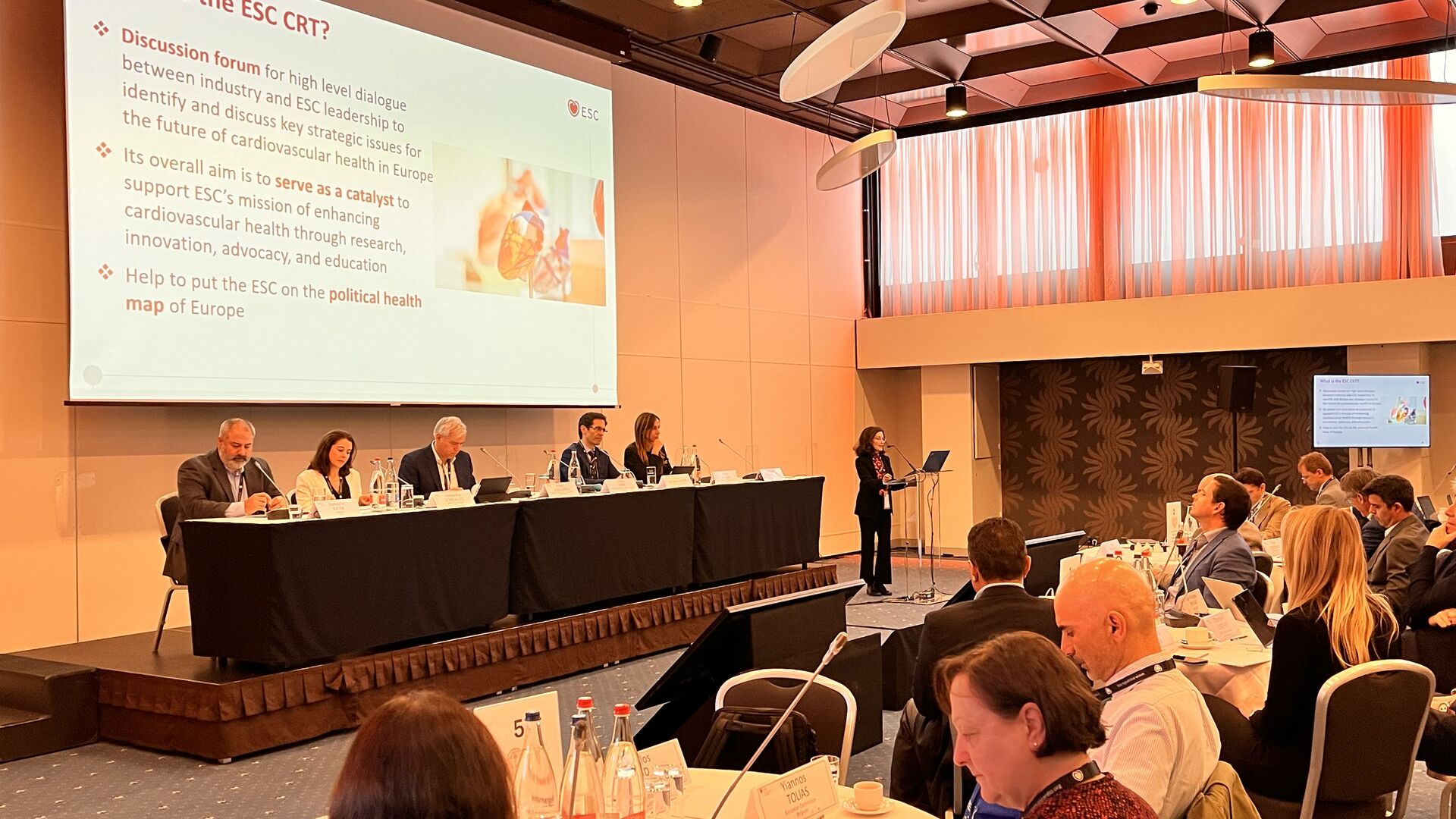
Objective of the CRT meeting
Trustworthy Implementation of AI in Clinical Practice
Overall objective
To establish a comprehensive and actionable roadmap for the trustworthy integration of AI into clinical practice within cardiology, ensuring that AI tools are reliable, evidence-based, and contribute to improved patient outcomes. This roadmap will be developed through collaboration between the medical industry, regulators, notified bodies, professional societies, policy makers, payers and patient representatives.
Specific objectives
- Developing an AI Implementation Roadmap:
- Identify key stakeholders involved in AI implementation.
- Outline the phases of implementation, from pilot projects to full integration.
- Establish milestones and timelines for each phase.
- Objective: To create a clear, step-by-step plan for the adoption of AI technologies in clinical practice.
- Discussion points:
- Ensuring Data Quality and Integrity:
- Identify key data sources and types of data required for AI algorithms.
- Develop strategies to minimise bias in data collection and processing.
- Discuss data governance and management practices, including patient privacy concerns.
- Address data harmonisation, common data models, federated learning and synthetic data generation for data sharing and evaluation of AI algorithms.
- Objective: To define standards and protocols for ensuring the quality, consistency, and reliability of data used in AI systems.
- Discussion Points:
- Creating a Framework for AI Evaluation:
- Define criteria for evaluating AI algorithms, including accuracy, transparency, and fairness.
- Discuss the role of independent third-party evaluations and certifications.
- Explore methods for continuous monitoring and post-market surveillance of AI tools within network of centres.
- Objective: To establish a robust framework for evaluating the safety, efficacy, and ethical considerations of AI tools before and after their deployment in clinical settings.
- Discussion Points:
- Defining Computable Disease Definitions and Outcomes:
- Identify diseases and outcomes that require standardised definitions.
- Harmonisation with existing definitions and deposit in centralised ESC phenotype platform.
- Discuss how these definitions can be used to support clinical decision-making and research.
- Objective: To develop standardised, computable definitions for diseases and clinical outcomes that can be consistently used across AI tools, guidelines, and clinical trials.
- Discussion Points:
- Establishing Evidence Requirements for AI in Clinical Trials:
- Discuss the need for rapid-cycle trials embedded within routine clinical care.
- Explore short-term outcome definitions that are suitable for AI validation.
- Identify the balance between rigorous evidence requirements and the need for timely innovation.
- Discuss the role of HTA.
- Objective: To determine the appropriate levels of evidence needed to validate AI tools in clinical trials, ensuring that these tools are both (cost-)effective and safe for patient care.
- Discussion Points:
- Engaging with Stakeholders:
- Facilitate dialogue between cardiologists, AI developers, and patient representatives.
- Address regulatory and policy challenges and opportunities related to AI in healthcare.
- Discuss the role of professional societies in guiding the ethical and effective use of AI.
- Objective: To ensure that the perspectives of all relevant stakeholders, including regulators, policy makers, payers, professional societies, patients, notified bodies and industry, are incorporated into the roadmap.
- Discussion Points:
- Planning Future Collaborations:
- Set the agenda for the next CRT meetings, focusing on unresolved issues and new developments.
- Identify working groups or committees to continue work on specific objectives.
- Discuss potential partnerships or funding opportunities to support the roadmap’s implementation.
- Objective: To outline the next steps and future meetings required to continue progress on the AI implementation roadmap.
- Discussion Points:
Academic Chairpersons

Professor Cecilia Marianne Linde
ESC President-Elect and ESC Chair of the CRT
Industry Chairpersons
Mrs Katarzyna Markiewicz
Philips
Professor Rodolphe Katra
Medtronic
Mrs Tamara Krcmar
Servier International

Doctor Alexandra Goncalves
BMC - Industry Chair of the CRT
Session recordings
Biographies
Final Programme
- 12:00-13:15 - Arrival and Buffet Lunch
- 13:15-13:20 - Welcome from the CRT Chairpersons by Alexandra Goncalves (BMS) and Cecilia Linde
- 13:15-13:20 - Welcome from the ESC President by Thomas F. Lüscher
- 13:20-15:30 - SESSION 1.1 – The road towards an ESC computable phenotype and outcome definition library, moderated by Folkert Asselbergs and Katarzyna Markiewicz (Philips)
- 13:20-13:40 - Health Systems of the next 25 years: How do we harness AI innovation to improve performance? by Martin McKee (European Observatory on Health Systems & Policies)
- 13:40-14:00 - Health Data Research UK and the British Heart Foundation (HDR UK/BHF) data science center phenotype library by Angela Wood
- 14:00-14:20 - Data standards: EuroHeart perspective by Stefan James
- 14:20-14:40 - How to leverage European Health Data Space (EHDS) and other regulatory initiatives to build computable phenotype and common outcome library? by Andrzej Ryś (European Commission)
- 14:40-15:00 - PANEL DISCUSSION
- 15:00-15:30 - Coffee Break
- 15:30-18:40 - SESSION 1.2 – Stakeholders perspective on AI adoption and implementation, moderated by Ruben Casado Arroyo and Tamara Krcmar (Servier International)
- 15:30-15:50 - Unmet needs in the clinical setting in the era of AI and Decision Support Systems by Carlos Pena
- 15:50-16:10 - AI In Healthcare - Yes, No and Maybe by Richard Stephens (ESC Patient Forum)
- 16:10-16:30 - Clinical and patient requirements for trustworthy AI: results of co-creation workshops of Trustworthy Artificial Intelligence for Personalized Risk Assessment in Chronic Heart Failure (AI4HF) European Union program by Carina Dantas (SHINE)
- 16:30-16:50 - European Medicines Regulatory Network. Key initiatives to adopt AI in Health Care by Florian Lasch (European Medicines Agency : EMA)
- 16:50-17:10 - Accelerating clinical value through engagement with big tech and startups: how the ESC can make a difference? by Guy Spigelman (Amazon Web Services)
- 17:10-17:20 - Coffee Break
- 17:20-18:40 - SESSION 1.3 – New solutions from the start-up world, moderated by Cecilia Linde and Alexandra Goncalves (BMS)
- 17:20-17:30 - AI impact on patient awareness, engagement and recruitment in routine care and clinical trials: the Elfie case (mobile intervention) by Jean François Legourd (Elfie) and Otavio Berwanger (Elfie)
- 17:30-17:40 - How is EIT Health supporting AI integration into the health innovation ecosystem? by Jérôme Fabiano (EIT-European Institute of Innovation and Technology)
- 17:40-17:50 - Generative AI in Healthcare: From (unstructured) data to insights & workflow automation - the HealthSage AI case by Marcel Alberti (Healthsage AI)
- 17:50-18:00 - Transforming Frontline Cardiovascular Patient Detection and Referral: PMcardio AI-powered ECG Platform by Robert Herman (Powerful Medical)
- 18:00-18:10 - Image-based home monitoring for the early detection of post surgical infection with AI by Simone Bottan (Hylomorph)
- 18:10-18:30 - PANEL DISCUSSION
- 18:30-18:40 - Wrap-up and Summary Day 1 – Outlook to Day 2 by Alexandra Goncalves (BMS) and Cecilia Linde
- END OF DAY 1
- 19:30 - APERITIF + DINNER
Day 2: 14 November 2024 08:30–12:30 CEST